


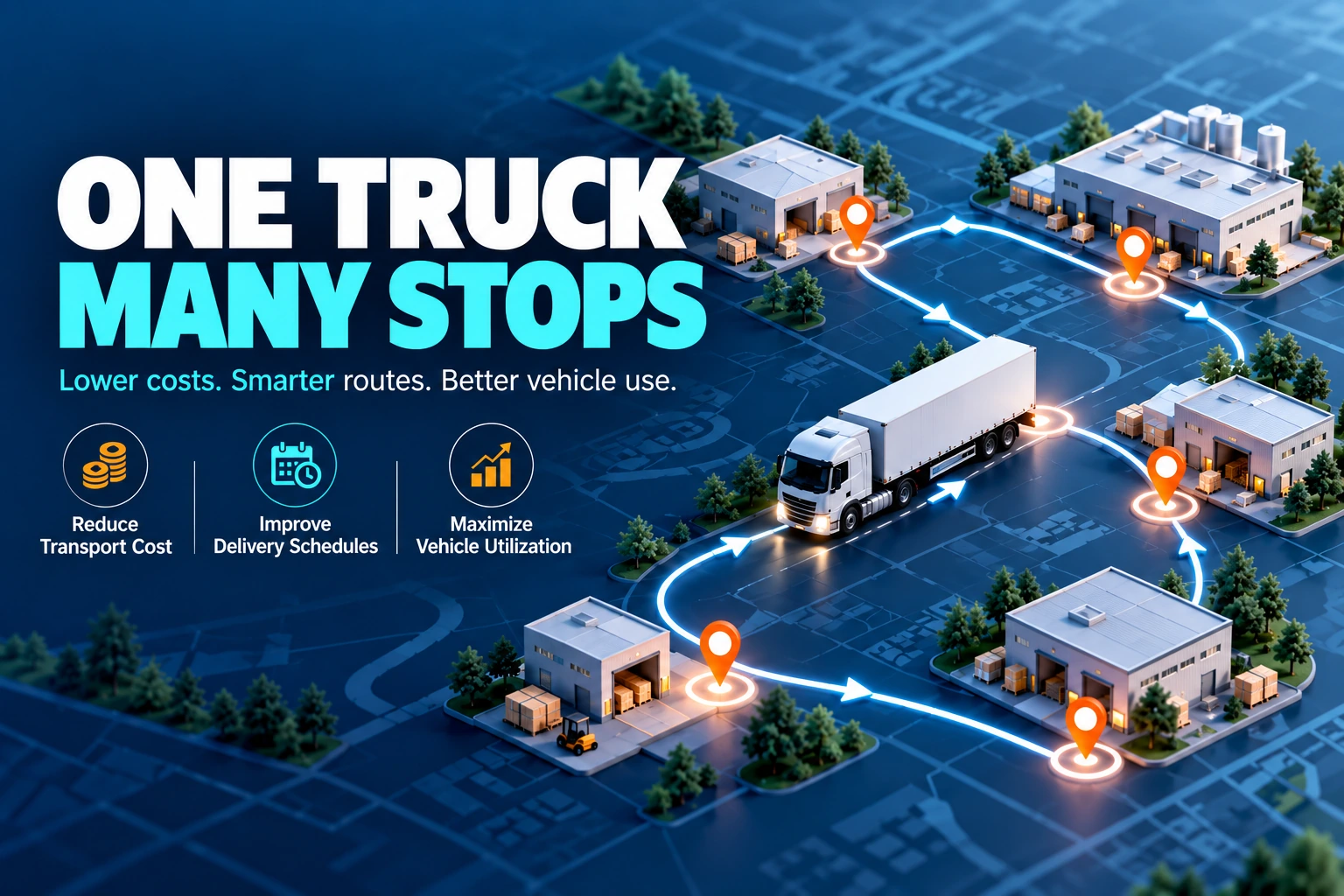
In modern supply chains, businesses are constantly looking for ways to reduce transportation costs, improve delivery schedules, and make better use of their vehicles. One logistics model that helps achieve these goals is Milk Run Logistics.
Unlike traditional transportation, where a vehicle may travel directly between one supplier and one destination, a milk run follows a planned route that allows a single vehicle to collect or deliver goods from multiple locations during the same trip.
This approach can help businesses improve vehicle utilization, reduce empty miles, control transportation costs, and create more predictable supply chains.
For manufacturers, retailers, distributors, and businesses managing regular supplier pickups, milk run logistics can be an efficient alternative to multiple individual transportation trips.
What Is Milk Run Logistics?
Milk run logistics is a transportation method in which one vehicle follows a predefined route and visits multiple suppliers, warehouses, distribution points, or customers to collect or deliver goods.
The concept comes from the traditional milk delivery system, where a milkman follows a fixed route and collects or delivers milk from multiple locations instead of making separate trips for every customer.
In supply chain management, the same principle is applied to freight transportation.
For example, imagine a manufacturer that receives materials from five different suppliers located within the same industrial region.
Instead of arranging five separate vehicles:
Supplier A → Factory
Supplier B → Factory
Supplier C → Factory
Supplier D → Factory
Supplier E → Factory
A milk run could operate as:
Factory → Supplier A → Supplier B → Supplier C → Supplier D → Supplier E → Factory
The route is planned according to supplier locations, shipment volumes, pickup schedules, vehicle capacity, and delivery requirements.
How Does Milk Run Logistics Work?
A successful milk run requires careful planning and coordination. The process generally involves the following steps.
1. Identify Suppliers and Delivery Locations
The first step is to identify the locations that need regular pickups or deliveries.
Businesses may consider:
- Supplier locations
- Warehouses
- Distribution centres
- Retail outlets
- Customer locations
- Manufacturing plants
- Expected shipment volumes
- Pickup and delivery frequency
Understanding these factors helps determine whether multiple locations can be efficiently combined into one route.
2. Plan the Transportation Route
Once the locations are identified, the logistics team creates an optimized route.
The objective is not simply to visit every location. The route should minimize unnecessary distance and travel time while ensuring that all required pickups or deliveries are completed within the agreed schedule.
Factors such as traffic, road conditions, loading time, delivery windows, and vehicle capacity can influence the final route.
3. Assign the Appropriate Vehicle
Vehicle selection is another important part of milk run planning.
The vehicle should have sufficient capacity for the combined shipments while remaining practical for the planned route.
Using an oversized vehicle may increase transportation costs, while an undersized vehicle may require additional trips.
4. Follow a Fixed Schedule
Milk runs typically operate according to a planned schedule.
For example:
8:00 AM – Supplier A
9:00 AM – Supplier B
10:15 AM – Supplier C
11:30 AM – Supplier D
1:00 PM – Manufacturing Plant
A predictable schedule allows suppliers and receiving teams to prepare goods before the vehicle arrives.
5. Consolidate the Shipments
Goods from multiple locations are consolidated into the same vehicle.
This can improve vehicle utilization and reduce the need to send separate vehicles for smaller shipments.
6. Track and Optimize the Route
Modern logistics operations can use GPS tracking, transportation management systems, digital documentation, and route planning tools to monitor vehicle movement.
Businesses can use this data to identify delays, inefficient routes, underutilized vehicles, and opportunities for further optimization.
Example of Milk Run Logistics
Consider an automobile component manufacturer that receives different components from several suppliers located around Pune.
The company requires regular deliveries from:
- Supplier A – metal components
- Supplier B – electrical parts
- Supplier C – plastic components
- Supplier D – packaging materials
A traditional model might involve four separate vehicles travelling from each supplier to the manufacturing facility.
With a milk run model, one scheduled vehicle can visit each supplier, collect the required materials, and return to the manufacturing facility.
This can reduce the number of individual trips and create a more structured inbound supply chain.
Benefits of Milk Run Logistics
Milk run logistics can provide several advantages when properly planned and managed.
1. Better Vehicle Utilization
Instead of using separate vehicles for small shipments, businesses can consolidate multiple shipments into one planned route.
This can help increase the amount of cargo transported per trip.
2. Lower Transportation Costs
Combining multiple pickups or deliveries can reduce the number of individual transportation trips.
Businesses may save on:
- Fuel
- Driver costs
- Toll expenses
- Vehicle operating costs
- Repeated loading and unloading expenses
The actual savings depend on shipment volumes, route distance, vehicle capacity, and operating conditions.
3. Reduced Empty Running
One common transportation challenge is vehicles travelling with unused capacity.
Milk run planning can help businesses reduce empty or partially loaded trips by combining shipments from multiple locations.
4. More Predictable Deliveries
Regular milk runs can operate on fixed schedules.
This creates greater predictability for both suppliers and receiving facilities.
Suppliers know when their goods are expected to be collected, while businesses can plan production and inventory around scheduled deliveries.
5. Better Inventory Management
When materials are collected according to a planned schedule, businesses can maintain a more controlled flow of inventory.
This can be particularly useful for manufacturers that require regular supplies of components.
6. Improved Supply Chain Visibility
When routes and schedules are standardized, businesses can monitor transportation performance more effectively.
Tracking information can help identify:
- Delays
- Missed pickups
- Route deviations
- Loading issues
- Vehicle utilization
- Delivery performance
7. Potential Environmental Benefits
Fewer transportation trips can potentially reduce fuel consumption and vehicle-related emissions.
However, the environmental benefit depends on how efficiently the route is designed and how much cargo is consolidated.
When Should Businesses Use Milk Run Logistics?
Milk run logistics is not suitable for every transportation requirement. It works particularly well when businesses have regular shipments between multiple nearby or strategically connected locations.
Businesses should consider a milk run when:
Suppliers Are Located Close to Each Other
If several suppliers operate within the same geographic area, combining pickups can make transportation more efficient.
Shipments Are Frequent but Relatively Small
Milk runs can be useful when suppliers regularly have smaller quantities ready for pickup.
Instead of waiting for a full truckload or sending separate vehicles, businesses can consolidate multiple shipments.
Delivery Schedules Are Predictable
A stable pickup or delivery schedule makes milk run planning easier.
Businesses with consistent daily, weekly, or scheduled transportation requirements are often better candidates.
Transportation Costs Are High
If a business is making many separate trips between suppliers and facilities, route consolidation may provide opportunities to reduce transportation expenses.
Businesses Want Better Control Over Inbound Logistics
Companies that want greater visibility and control over supplier pickups can use planned milk runs to standardize transportation operations.
When Is Milk Run Logistics Not the Best Option?
Milk run logistics can be highly effective, but it is not always the right solution.
A direct transportation model may be better when:
- A shipment requires urgent delivery.
- The cargo is extremely large or heavy.
- Suppliers are located very far apart.
- Delivery locations have completely different schedules.
- The goods require specialized transportation.
- The route would involve excessive detours.
- Shipment volumes already justify dedicated vehicles.
For these situations, combining multiple stops could increase travel time and create unnecessary complexity.
Milk Run vs. Traditional Transportation
| Factor | Milk Run Logistics | Traditional Direct Transportation |
| Number of stops | Multiple | Usually one or limited |
| Route | Planned multi-stop route | Direct route |
| Shipment consolidation | High potential | Usually lower |
| Vehicle utilization | Can be improved | Depends on shipment size |
| Scheduling | Structured | Often shipment-specific |
| Best suited for | Regular multi-location shipments | Dedicated or urgent shipments |
| Transportation efficiency | High when properly planned | Can be lower for small shipments |
The right approach depends on shipment characteristics, delivery requirements, geography, and business priorities.
Industries That Can Benefit From Milk Run Logistics
Several industries can use milk run transportation effectively, including:
Automotive
Automotive manufacturers often receive components from multiple suppliers on regular schedules. Milk runs can help create a predictable inbound supply of parts.
Manufacturing
Factories sourcing raw materials, components, or packaging from multiple suppliers can use milk runs to consolidate regular pickups.
Retail
Retail businesses with multiple stores or distribution points may use planned routes to replenish inventory.
FMCG
Fast-moving consumer goods companies can benefit from structured transportation routes for regular distribution requirements.
Electronics
Manufacturers and distributors dealing with multiple component suppliers may use milk runs for scheduled material collection.
E-commerce and Distribution
Businesses with predictable delivery clusters can explore route consolidation to improve delivery efficiency.
How Technology Improves Milk Run Operations
Technology plays an important role in modern milk run logistics.
Businesses can use:
GPS Tracking: Monitor vehicle locations and route progress in real time.
Route Optimization: Identify efficient routes based on distance, traffic, delivery windows, and vehicle capacity.
Digital Proof of Delivery: Replace paper-based delivery records with digital documentation.
Transportation Management Systems: Coordinate shipments, routes, vehicles, schedules, and transportation data.
Analytics: Analyze transportation costs, delivery performance, vehicle utilization, and route efficiency.
When technology and logistics planning work together, businesses can make milk run operations more predictable and measurable.
Key Factors to Consider Before Implementing a Milk Run
Before switching to a milk run model, businesses should evaluate:
- Number of pickup and delivery locations
- Distance between locations
- Shipment frequency
- Average shipment size
- Vehicle capacity
- Pickup and delivery time windows
- Loading and unloading times
- Traffic conditions
- Road accessibility
- Product handling requirements
- Transportation costs
- Required delivery frequency
A route that looks efficient on paper may not perform well if loading times, traffic, or delivery restrictions are ignored.
How SK Translines Can Help
Efficient transportation is not simply about moving goods from Point A to Point B. It is about designing transportation operations that support cost control, timely deliveries, vehicle utilization, and overall supply chain efficiency.
At SK Translines, businesses can explore transportation solutions based on their shipment requirements, routes, schedules, and operational needs.
Whether you need regular transportation, multi-location pickups, distribution support, or customized logistics planning, working with an experienced logistics partner can help you build a more organized and efficient transportation process.
Final Thoughts
Milk run logistics can be a practical solution for businesses that manage frequent, smaller shipments across multiple locations.
By consolidating pickups or deliveries into planned routes, businesses can potentially improve vehicle utilization, reduce unnecessary trips, create predictable schedules, and gain better control over transportation operations.
However, milk run logistics should not be implemented simply because it sounds cost-effective. Businesses need to evaluate shipment volumes, locations, delivery windows, vehicle capacity and route conditions before deciding whether it is the right model.
For organizations with the right transportation profile, a well-designed milk run can become an important part of a more efficient and responsive supply chain.
Looking for reliable transportation and logistics solutions for your business? Connect with SK Translines to discuss your transportation requirements.