


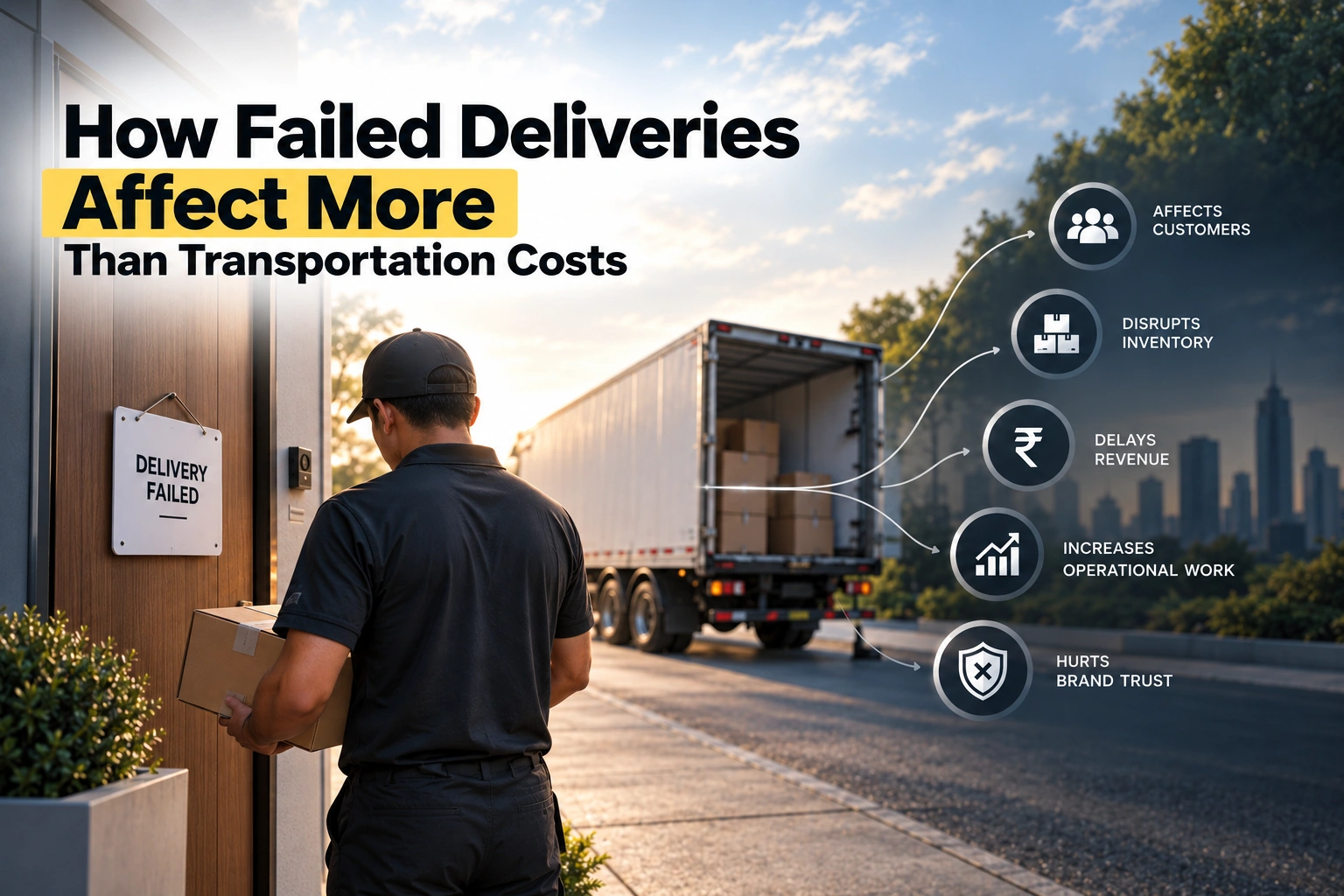
A failed delivery may seem like a simple transportation issue.
A shipment could not be delivered, so the vehicle returns, the delivery is rescheduled, and the logistics team tries again.
But the real impact goes far beyond the cost of another trip.
Failed deliveries can affect customer relationships, inventory planning, workforce productivity, cash flow, operational efficiency, and even brand reputation.
In logistics, one unsuccessful delivery can create a chain reaction across the entire business.
The Obvious Cost: Another Trip
The most visible cost of a failed delivery is the additional transportation expense.
A second delivery attempt means more fuel, more driver time, more vehicle usage, and potentially additional tolls or route costs.
If failed deliveries happen frequently, these expenses can quickly accumulate.
But transportation is only the beginning.
The less visible costs are often more damaging.
1. Vehicle Capacity Gets Wasted
Every vehicle has a limited number of productive hours in a day.
When a delivery fails, the shipment may need to remain on the vehicle, return to a warehouse, or be scheduled for another trip.
That uses capacity that could have been assigned to another customer.
The result is reduced fleet productivity.
A vehicle that should have completed several deliveries may instead spend valuable time handling the same shipment twice.
2. Driver Productivity Falls
Failed deliveries also affect driver schedules.
Drivers may need to wait at a location, contact the customer, coordinate with dispatch teams, update documentation, return with undelivered goods, and repeat the journey later.
All of this consumes time.
When this happens across multiple vehicles, it can significantly reduce the number of productive deliveries completed each day.
3. Warehouses Face Extra Work
A failed delivery often creates additional work for warehouse teams.
Returned goods may need to be:
- Received again
- Inspected
- Re-entered into inventory
- Stored temporarily
- Repacked
- Prepared for another dispatch
This creates additional handling that would not have been necessary if the first delivery attempt had succeeded.
It can also increase the risk of product damage, misplacement, or documentation errors.
4. Inventory Visibility Becomes More Complicated
Once a shipment leaves a warehouse, businesses often expect the inventory to reach the customer.
But when that delivery fails, the product enters an uncertain stage.
Is it still in the vehicle?
Has it returned to the warehouse?
Is it scheduled for redelivery?
Can it be reassigned?
Without strong tracking systems, failed deliveries can create confusion between physical inventory and system records.
That can affect stock planning and future order fulfilment.
5. Customer Experience Takes a Hit
Customers usually do not see the operational challenges behind a failed delivery.
They simply see that their shipment did not arrive as expected.
Repeated delivery failures can lead to:
- Customer complaints
- Loss of trust
- Increased support calls
- Order cancellations
- Negative reviews
- Reduced repeat business
Even when the logistics provider eventually completes the delivery, the customer’s overall experience may already have been affected.
Reliable delivery is therefore not only an operational requirement.
It is part of the customer experience.
6. Cash Flow Can Be Delayed
In many businesses, payment is linked to successful delivery.
If the delivery fails, invoicing or payment collection may also be delayed.
For businesses handling large shipment volumes, repeated delays can affect working capital.
This means delivery performance can influence finance just as much as transportation.
7. Customer Service Workload Increases
Every failed delivery usually creates additional communication.
Customers want to know:
Where is my shipment?
Why was the delivery unsuccessful?
When will the next attempt happen?
Operations teams, customer service representatives, drivers, and dispatchers may all become involved.
This increases administrative workload and takes employees away from other productive tasks.
Why Do Deliveries Fail?
Many delivery failures can be traced to operational issues such as:
- Incorrect delivery addresses
- Customer unavailability
- Poor delivery scheduling
- Incomplete documentation
- Vehicle access restrictions
- Coordination problems
- Delays earlier in the route
- Incorrect shipment information
The important step is not just recording that a delivery failed.
Businesses should record why it failed.
Once failure reasons are categorized, patterns become easier to identify.
Measure Failed Deliveries as an Operational KPI
Companies should track more than just the number of successful deliveries.
Useful metrics can include:
First-attempt delivery success rate
Number of redelivery attempts
Cost per failed delivery
Primary failure reasons
Customer-wise failure rate
Route-wise failure rate
Average redelivery delay
These metrics help identify where operational improvements can create the biggest impact.
Preventing Failure Is Cheaper Than Managing It
A strong logistics operation is not simply one that can respond quickly when something goes wrong.
It is one that reduces the chances of failure in the first place.
Better address verification, customer communication, route planning, shipment tracking, driver coordination, and delivery scheduling can all improve first-attempt delivery success.
Even a small improvement in delivery success rates can reduce unnecessary kilometres, vehicle usage, customer complaints, and operational workload.
Every Successful First Attempt Matters
The true cost of a failed delivery is not limited to fuel and transportation.
It affects vehicles, drivers, warehouses, inventory, finance, customer service, and customer satisfaction.
At S K Translines, reliable logistics is about more than moving goods.
It is about planning carefully, maintaining visibility, coordinating efficiently, and helping shipments reach their destination successfully the first time.
Because in logistics, the most efficient delivery is not the one that is completed fastest.
It is the one that does not need to be done twice.