


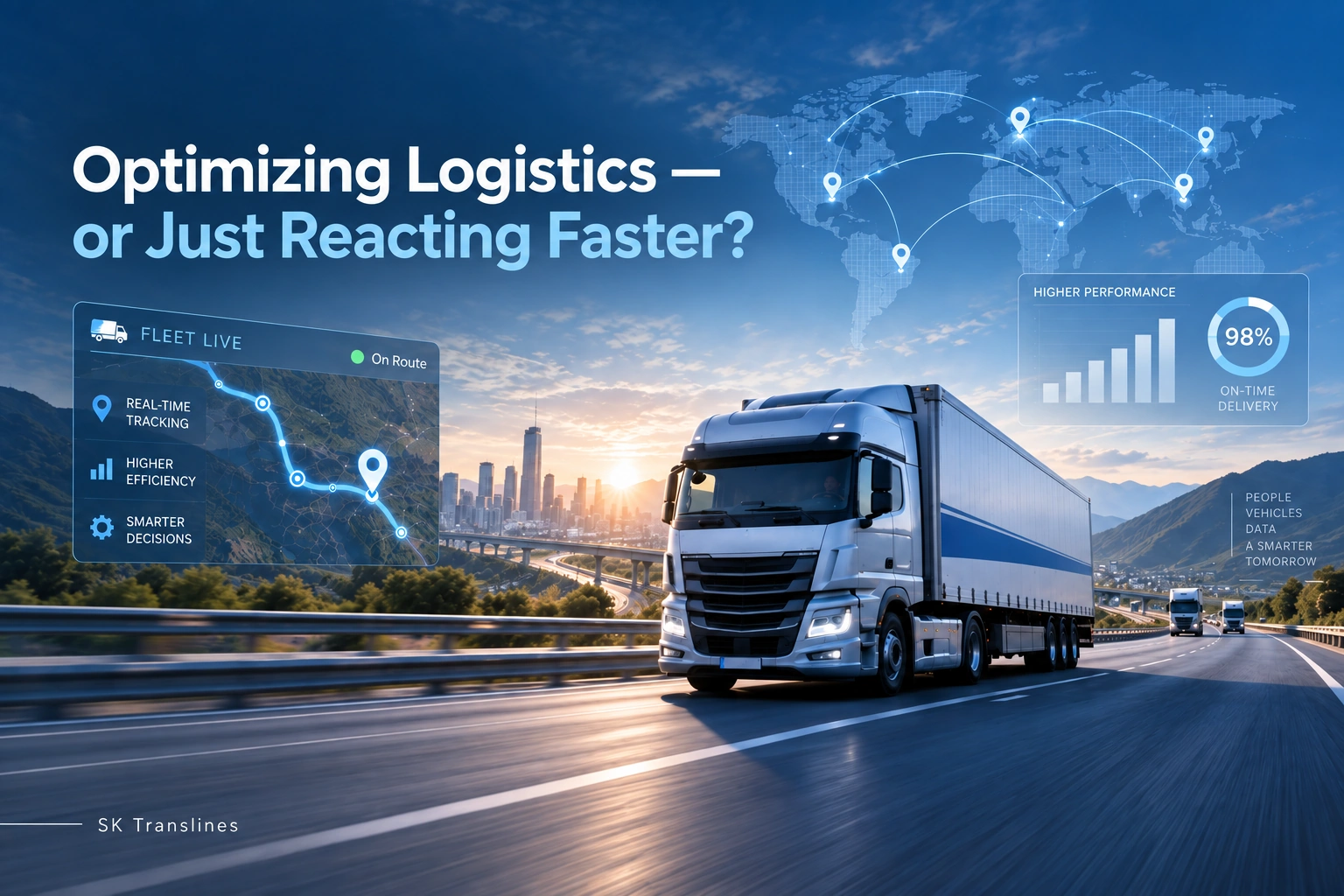
In logistics, speed matters. But there is an important difference between moving faster and operating smarter.
Many logistics operations become very good at responding to problems quickly. A vehicle breaks down, a shipment gets delayed, a route gets blocked, or a customer raises an urgent request—and the team reacts immediately.
That may look like efficiency.
But if the same problems keep happening, faster reactions are not necessarily optimization. They are simply better firefighting.
True logistics optimization begins when businesses stop asking:
“How quickly can we solve this problem?”
and start asking:
“Why is this problem happening repeatedly, and how can we prevent it?”
The Difference Between Reaction and Optimization
A reactive logistics operation focuses on what is happening right now.
A truck is delayed, so another vehicle is arranged.
A route becomes congested, so the driver takes an alternative route.
A customer requests an update, so the operations team calls the driver.
These actions are necessary, but they are short-term solutions.
An optimized logistics operation goes deeper.
It studies historical delivery performance, identifies recurring delays, monitors vehicle utilization, improves route planning, tracks operational costs, and uses data to reduce the chances of the same issue happening again.
The goal is not simply to react faster.
The goal is to reduce the number of situations that require urgent reactions in the first place.
1. Faster Deliveries Do Not Always Mean Better Logistics
Reducing delivery time can be valuable, but speed alone does not define logistics performance.
A delivery may arrive quickly while still involving:
- Excess fuel consumption
- Poor vehicle utilization
- Unnecessary empty kilometres
- Higher driver overtime
- Expensive last-minute rerouting
- Repeated coordination between teams
If delivery speed improves while operating costs continue to increase, the logistics network may not actually be improving.
Optimization looks at the complete picture.
The objective is to achieve reliable delivery performance while controlling costs, improving resource utilization, and maintaining service consistency.
2. Repeated Problems Are Operational Data
Recurring logistics problems should not be treated as isolated incidents.
If deliveries on a particular route are frequently delayed, there may be a route planning issue.
If a certain vehicle regularly experiences maintenance problems, preventive maintenance schedules may need improvement.
If drivers frequently wait at loading or unloading locations, the problem could be related to scheduling, documentation, or coordination.
Every repeated operational issue contains useful information.
Instead of solving the same problem repeatedly, logistics teams should analyze the pattern behind it.
That is where optimization begins.
3. Route Planning Should Be Dynamic
The shortest route is not always the most efficient route.
Road conditions, traffic congestion, loading restrictions, toll costs, delivery windows, vehicle type, and customer location can all influence the best route.
Effective route planning should therefore consider more than distance.
Businesses should regularly evaluate:
- Route performance
- Average transit times
- Fuel consumption
- Driver waiting time
- Delivery frequency
- Vehicle capacity
- Alternative routes
Small improvements across frequently used routes can create significant savings over time.
4. Vehicle Utilization Matters as Much as Vehicle Availability
Having vehicles available is important.
Using them efficiently is even more important.
A fleet may appear busy while still operating inefficiently because of partially loaded vehicles, unnecessary trips, poor trip scheduling, or excessive empty return journeys.
Logistics optimization requires visibility into how every vehicle is being used.
Important questions include:
Is the right vehicle being assigned to the right shipment?
Can multiple loads be planned more efficiently?
Are vehicles returning empty unnecessarily?
Are certain vehicles overloaded while others remain underutilized?
Improving utilization can reduce cost per shipment without necessarily increasing fleet size.
5. Real-Time Visibility Should Support Better Decisions
GPS tracking and real-time shipment visibility have transformed logistics operations.
But visibility itself is not optimization.
Knowing that a truck is delayed is useful.
Understanding why similar trucks are repeatedly delayed on the same route is far more valuable.
Tracking systems should help logistics teams move beyond monitoring and toward decision-making.
Historical tracking data can help identify:
- Consistently slow routes
- Long loading and unloading times
- Frequent stoppages
- Unexpected deviations
- Underperforming delivery zones
- Opportunities for route consolidation
Real-time information solves today’s problem.
Historical information can help prevent tomorrow’s problem.
6. Preventive Maintenance Is Part of Logistics Optimization
Unexpected vehicle breakdowns can create cascading problems across the supply chain.
A single vehicle failure may result in delayed deliveries, emergency vehicle replacement, additional driver coordination, customer dissatisfaction, and increased operating costs.
Reactive maintenance addresses the vehicle after the problem occurs.
Preventive maintenance reduces the likelihood of that disruption happening.
Monitoring vehicle servicing schedules, tyre condition, engine performance, mileage, and recurring repair issues helps keep fleets more reliable.
A well-maintained fleet does not just reduce repair costs.
It improves the predictability of the entire logistics operation.
7. Measure the Right Logistics KPIs
Businesses often focus heavily on delivery speed, but logistics performance should be measured across multiple dimensions.
Useful metrics can include:
- On-time delivery percentage
- Cost per kilometre
- Cost per shipment
- Vehicle utilization
- Empty kilometres
- Average loading time
- Average unloading time
- Fuel efficiency
- Vehicle downtime
- Damage percentage
- Customer complaints
- Route-wise delivery performance
Tracking these metrics over time provides a clearer picture of whether logistics operations are actually improving.
Optimization should be measurable.
From Faster Reactions to Smarter Logistics
Unexpected situations will always exist in logistics.
Traffic changes. Vehicles develop problems. Customer requirements change. Weather disrupts routes. Loading schedules get delayed.
Strong logistics teams must be able to respond quickly.
But the most efficient operations do more than respond.
They learn from every shipment, every delay, every route, and every operational issue.
They use technology, experience, data, and planning to continuously improve how goods move.
Because the real objective is not to become better at firefighting.
It is to build logistics operations that require less firefighting in the first place.
Moving Logistics Forward with SK Translines
At S K Translines, efficient logistics is built around planning, operational visibility, fleet management, reliable transportation, and consistent execution.
With decades of industry experience and technology-supported logistics operations, we help businesses move beyond reactive transportation and build more dependable supply chains.
Because smarter logistics is not simply about reaching the destination faster.
It is about finding a better way to reach it—every single time.