


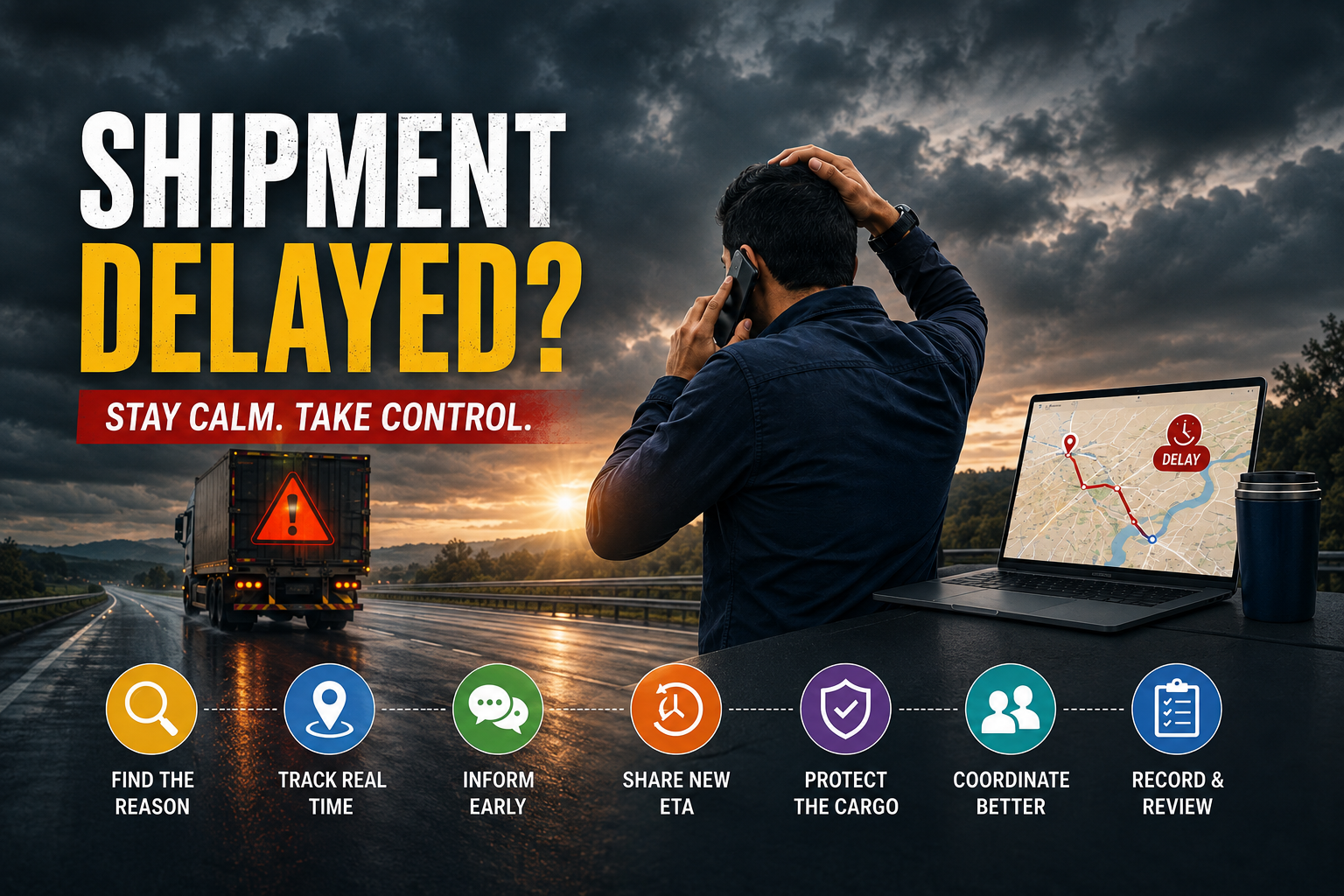
Shipment delays are one of the most common challenges in logistics. Traffic congestion, vehicle breakdowns, bad weather, documentation issues, route restrictions or operational problems can affect even a well-planned delivery.
Although every delay cannot be prevented, the way a business responds can make a major difference. Quick communication, accurate tracking and proper contingency planning can protect customer relationships and reduce financial losses.
Here is what businesses should do when a shipment is delayed.
1. Identify the Reason for the Delay
The first step is to understand exactly why the shipment has been delayed.
Contact the transporter or driver and check the latest shipment status. Determine whether the delay is caused by:
- Heavy traffic or road closures
- Vehicle breakdown
- Weather conditions
- Driver availability issues
- Incorrect or incomplete documents
- Checkpost or regulatory delays
- Loading or unloading problems
- Warehouse congestion
- Changes in the delivery schedule
Knowing the actual reason helps you estimate the impact and decide the next action.
2. Track the Shipment’s Current Location
Use GPS tracking, transport management software or direct driver communication to confirm where the shipment is currently located.
Real-time location information helps logistics teams understand:
- How far the shipment is from the destination
- Whether the vehicle is moving or stationary
- How long the delay may continue
- Whether an alternative route is available
- Whether additional support is required
Avoid making delivery promises until the shipment’s current position and condition are confirmed.
3. Inform the Customer Immediately
Customers should not discover a shipment delay after the expected delivery time has already passed.
Once the delay is confirmed, inform the customer clearly and professionally. Share:
- The reason for the delay
- The shipment’s current status
- The revised expected delivery time
- The steps being taken to resolve the issue
- The next update schedule
Transparent communication reduces frustration and builds trust, even when the delay cannot be avoided.
4. Provide a Realistic Revised Delivery Time
Do not offer an overly optimistic delivery estimate just to reassure the customer.
Consider the actual distance remaining, road conditions, driver rest requirements, unloading availability and the time needed to resolve the problem.
It is better to provide a realistic delivery window than repeatedly change the expected time.
5. Explore Alternative Routes or Vehicles
Depending on the cause of the delay, the transporter may be able to reduce the impact by using:
- An alternate route
- A replacement vehicle
- A backup driver
- Transshipment to another truck
- A nearby warehouse or temporary storage facility
- A different delivery time slot
However, any change should be planned carefully to avoid cargo damage, documentation errors or additional delays.
6. Protect the Cargo
When a shipment is delayed, the safety of the goods becomes especially important.
Check whether the cargo requires:
- Temperature control
- Protection from rain or moisture
- Additional security
- Safe parking
- Regular inspection
- Special handling
- Repositioning or reloading
For perishable, fragile, high-value or time-sensitive goods, the transporter should continuously monitor the condition of the cargo.
7. Check the Documents
Documentation problems are a frequent cause of transportation delays.
Verify that the shipment has all required documents, such as:
- Invoice
- E-way bill
- Lorry receipt
- Delivery challan
- Vehicle documents
- Permit or transit documents
- Insurance papers
- Proof of tax compliance
If a document is missing, incorrect or expired, correct it as quickly as possible and share the updated copy with the driver or transporter.
8. Coordinate With the Destination Team
A delay can also affect warehouse operations, unloading labour and vehicle scheduling at the destination.
Inform the receiving team about the revised arrival time so they can adjust:
- Labour availability
- Loading dock schedules
- Storage arrangements
- Forklift or crane requirements
- Customer delivery plans
- Production schedules
This prevents the shipment from facing another delay after reaching the destination.
9. Maintain a Record of the Incident
Keep a proper record of the delay, including:
- Date and time of the incident
- Reason for the delay
- Vehicle and shipment details
- Driver communication
- Customer updates
- Revised delivery estimates
- Additional costs
- Corrective actions taken
These records are helpful for resolving disputes, processing insurance claims and identifying repeated operational problems.
10. Review the Delay After Delivery
Once the shipment is delivered, analyse what went wrong.
Ask questions such as:
- Could the delay have been predicted?
- Was the route planned correctly?
- Were the documents checked before dispatch?
- Was the vehicle properly maintained?
- Was the customer informed on time?
- Was a backup plan available?
The goal is not only to solve the current problem but also to prevent similar delays in future shipments.
How Businesses Can Reduce Future Shipment Delays
Businesses can minimise delays by improving planning and visibility across the supply chain.
Helpful measures include:
- Using GPS-enabled vehicles
- Selecting reliable transport partners
- Maintaining vehicles regularly
- Verifying documents before dispatch
- Planning alternate routes
- Keeping buffer time for critical deliveries
- Monitoring weather and traffic conditions
- Maintaining clear communication with drivers
- Using transport management software
- Preparing backup vehicles and drivers
Proper planning cannot eliminate every delay, but it can significantly reduce the impact.
Final Thoughts
Shipment delays can disrupt operations, increase costs and affect customer satisfaction. However, panic and poor communication often make the situation worse.
The best response is to identify the cause, track the shipment, protect the cargo, inform the customer and create a realistic recovery plan.
A business that manages delays professionally can protect customer trust and turn a difficult situation into an opportunity to demonstrate reliability, transparency and strong logistics management.