


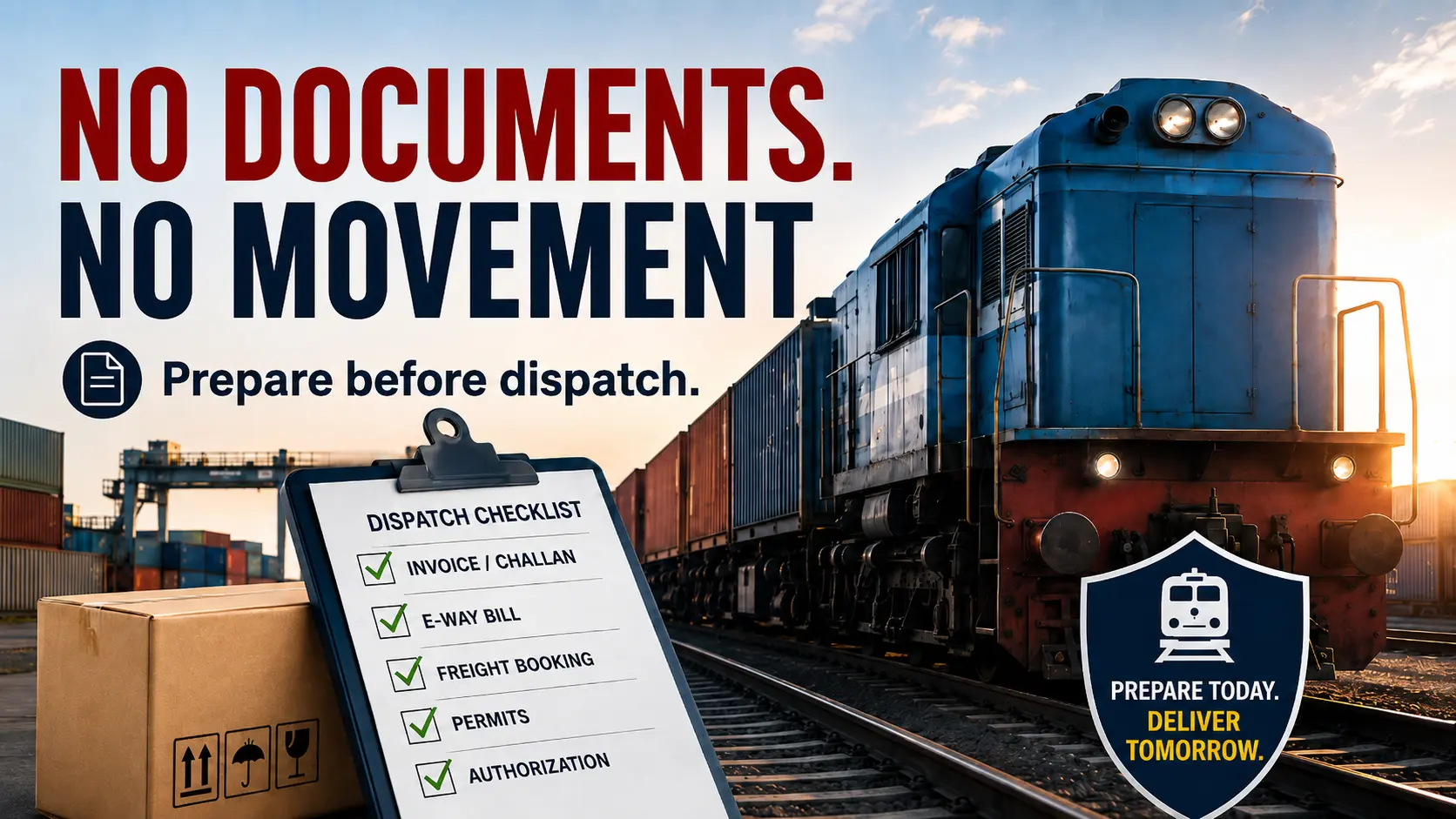
Rail freight is an efficient option for transporting bulk commodities, industrial materials, agricultural goods and containerised cargo across India. However, delays often occur before the train even moves because booking information is incomplete, tax documents do not match or commodity-specific approvals are missing.
Preparing the correct documents in advance helps shippers avoid booking delays, incorrect freight calculations, delivery issues and compliance problems.
Why Accurate Documentation Matters
Rail freight involves coordination between the consignor, consignee, railway authorities, loading point, destination terminal and sometimes a road transporter for first-mile or last-mile movement.
A small mismatch in the product description, weight, GSTIN, destination station or Railway Receipt number can interrupt the shipment process. Shippers should therefore verify that the information is consistent across every commercial, railway and regulatory document.
1. Tax Invoice, Bill of Supply or Delivery Challan
The shipment should be supported by the appropriate commercial document.
Depending on the transaction, this may be:
- A tax invoice for taxable goods
- A bill of supply for exempt goods or eligible suppliers
- A delivery challan when goods move without an immediate sale, such as stock transfers, job work, repairs or exhibition movements
The document should clearly mention the consignor and consignee details, GSTINs, invoice number and date, product description, HSN code, quantity, taxable value and applicable GST. GST rules require goods in transit to be supported by an invoice, bill of supply or delivery challan, as applicable.
2. E-Way Bill
An e-way bill must be generated wherever required under GST rules. For rail movement, the responsibility generally lies with the registered supplier or recipient rather than Indian Railways.
Railways may not deliver goods at the destination unless the required e-way bill is produced. For rail shipments, relevant transport information can be updated before or after the movement begins, subject to the applicable rules.
Shippers should verify:
- Invoice or challan number
- Dispatch and delivery locations
- Consignor and consignee GSTIN
- Product value and HSN details
- Mode of transport
- Railway Receipt number
The current e-way bill system is integrated with Indian Railways. The Railway Receipt or Parcel Way Bill number must be entered exactly as printed, without changing its format.
3. Forwarding Note
The forwarding note is one of the main documents used for booking goods through Indian Railways. It records the shipment information declared by the consignor and forms the basis for preparing the Railway Receipt.
A forwarding note commonly includes:
- Names and addresses of the consignor and consignee
- Origin and destination railway stations
- Description of the commodity
- Number of packages
- Declared weight
- Packaging condition
- Preferred route, where relevant
- Declared value of the cargo
- Risk-rate selection and other booking declarations
The consignor is responsible for ensuring that the commodity description, weight and other details entered in the forwarding note are accurate.
Regular freight customers may also use electronic demand and booking facilities available through the Freight Operations Information System.
4. Freight Demand or Booking Registration
For wagonload or trainload movements, shippers may need to register their freight demand before loading.
The booking request may include:
- Origin and destination
- Commodity type
- Number and type of wagons required
- Expected loading date
- Approximate cargo weight
- Consignor and consignee details
- Payment arrangement
- Loading location
Indian Railways provides online demand registration facilities through FOIS and RailSAHAY. A demand becomes ready for further processing after the required forwarding-note details and related booking information are completed.
Shippers should retain the demand number, forwarding-note number and booking confirmation for internal coordination.
5. Commodity-Specific Permissions
Certain goods require additional declarations, permits or certificates before they can be accepted for rail transport.
Examples may include:
- Dangerous or hazardous materials
- Explosives and inflammable goods
- Petroleum or chemical products
- Animals and birds
- Restricted commodities
- Food, agricultural or temperature-sensitive goods
- Over-dimensional or unusually heavy cargo
Dangerous goods are governed by specialised railway requirements and may need a dedicated forwarding note, safety declarations, approved packaging and supporting certificates.
Shippers should check the requirements with the relevant railway freight office before bringing specialised cargo to the loading point.
6. Packing List and Cargo Identification
A detailed packing list may not replace the invoice or forwarding note, but it helps verify the physical cargo.
It should include:
- Package count
- Product description
- Gross and net weight
- Package dimensions
- Batch or serial numbers
- Marks and labels
- Handling instructions
Every package should display clear consignee details, destination information and identification marks. Suitable packaging is especially important because defective or inadequate packing may be recorded in the forwarding note and Railway Receipt.
7. Authorisation Documents
When an employee, transport contractor, customs broker or other representative completes the booking, the shipper should provide an authorisation letter.
The representative should also carry:
- Company identification
- Contact details of the authorised signatory
- Copies of booking documents
- GST and company details
- Payment authorisation, where necessary
This reduces confusion at the terminal and ensures that the person handling the cargo is authorised to sign documents or receive the Railway Receipt.
8. Railway Receipt
The Railway Receipt, commonly called the RR, is generated after the consignment is accepted and booked.
Registered customers can opt for an electronic Railway Receipt, or eT-RR, which may be shared through their registered email address.
Before accepting the RR, the shipper should verify:
- Consignor and consignee details
- Origin and destination
- Commodity description
- Weight and package count
- Freight payment status
- Special remarks
- Railway Receipt number
The RR is an important document for cargo tracking and delivery. Indian Railways normally delivers the consignment against surrender or verification of the Railway Receipt, subject to applicable electronic and indemnity procedures.
Final Pre-Dispatch Checklist
Before sending cargo to the railway terminal, shippers should confirm that:
- The booking or demand has been registered
- The invoice, bill of supply or challan is accurate
- The e-way bill is generated where applicable
- Consignor and consignee details match everywhere
- The forwarding note is complete
- Weight and package count are verified
- Packages are properly labelled
- Commodity permits are available
- First-mile vehicle and driver details are coordinated
- The authorised representative has all required documents
Conclusion
Successful rail dispatch depends on more than wagon availability. It requires accurate commercial records, railway booking documents, GST compliance and proper cargo preparation.
By preparing the documentation early and checking that every detail matches, shippers can reduce terminal delays, prevent delivery problems and make their rail freight operations more reliable.
Because requirements may differ according to the commodity, route, booking type and current railway restrictions, businesses should confirm shipment-specific requirements with the relevant railway loading station before dispatch.