


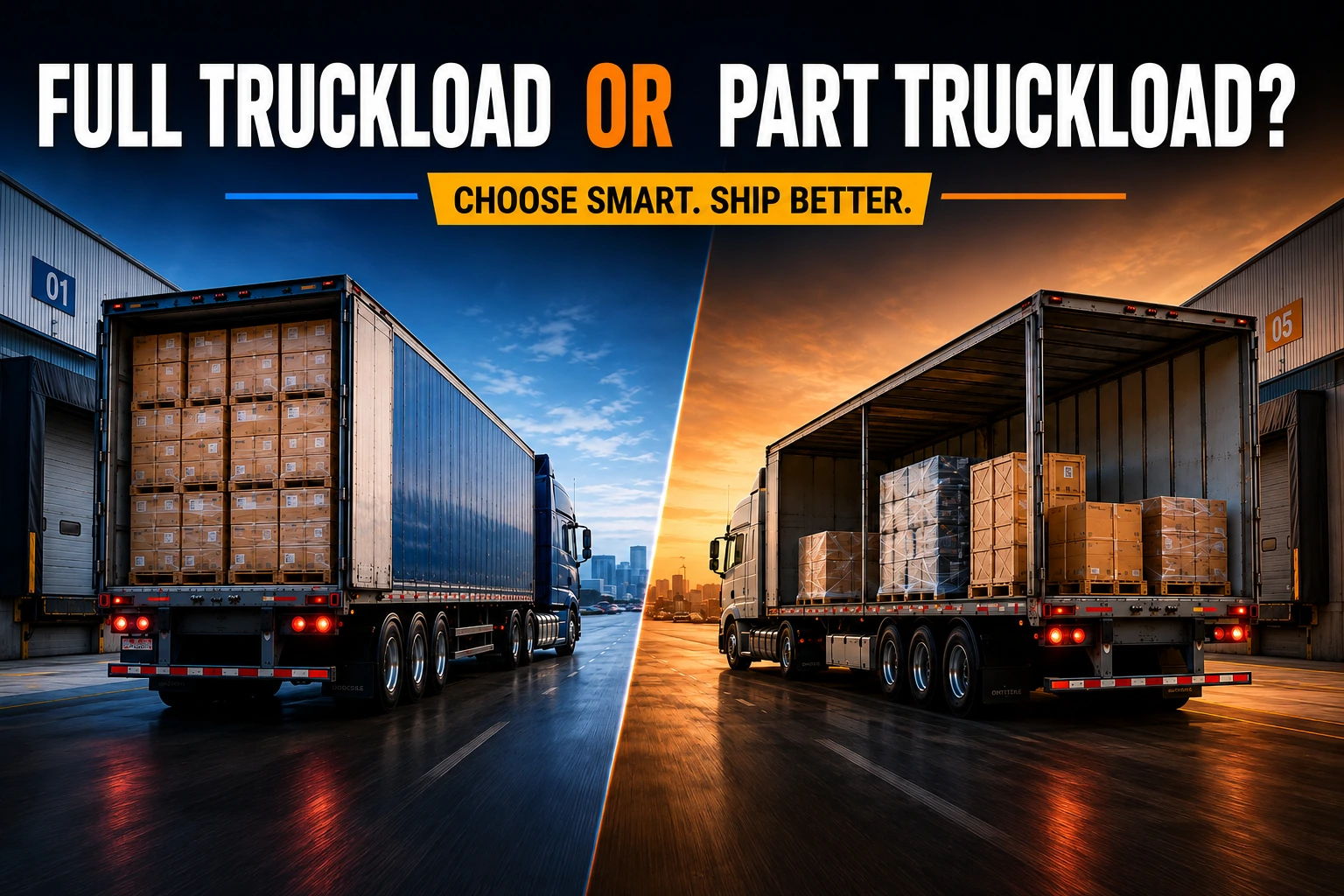
Choosing the right transportation method can directly affect your delivery time, freight cost and cargo safety. Two of the most common road freight options are Full Truckload (FTL) and Part Truckload (PTL).
Both options are useful, but the right choice depends on the size of your shipment, delivery urgency, budget and handling requirements.
What Is Full Truckload Transportation?
Full Truckload transportation means that an entire truck is reserved for one customer’s shipment. Your goods occupy the complete vehicle, even when the available truck space is not fully used.
The truck usually travels directly from the pickup location to the delivery destination without combining cargo from other businesses.
Full Truckload is suitable when:
- You have a large or heavy shipment
- Your goods can fill most of the truck
- The shipment requires faster delivery
- Your cargo is fragile, valuable or sensitive
- You want fewer loading and unloading activities
- You require a dedicated vehicle
What Is Part Truckload Transportation?
Part Truckload transportation allows multiple customers to share space in the same truck. Each customer pays only for the portion of the vehicle occupied by their shipment.
The transporter collects different shipments travelling along similar routes and delivers them to their respective destinations.
Part Truckload is suitable when:
- Your shipment is small or medium-sized
- You do not need an entire truck
- You want to reduce transportation costs
- Your delivery schedule is flexible
- Your goods can safely travel with other shipments
- You send smaller shipments regularly
Full Truckload vs Part Truckload
1. Shipment Size
FTL is generally better for large shipments that occupy most or all of the truck.
PTL is more practical for smaller shipments that require only limited vehicle space.
2. Transportation Cost
With FTL, the customer pays for the complete truck, making it more economical for large-volume shipments.
With PTL, the transportation cost is divided among multiple customers. This makes it a cost-effective option for smaller loads.
3. Delivery Speed
FTL shipments usually move directly from the pickup point to the destination. As a result, delivery is often faster and more predictable.
PTL shipments may involve multiple pickup points, unloading locations or transport hubs. Therefore, the delivery time may be slightly longer.
4. Cargo Handling
FTL cargo is loaded at the origin and normally unloaded only at the final destination. Fewer handling points reduce the risk of damage or misplacement.
PTL shipments may be loaded, sorted or transferred multiple times during transportation. Proper packaging and labelling are therefore extremely important.
5. Shipment Safety
FTL offers greater control over the shipment because the truck carries goods belonging to only one customer. It is often preferred for fragile, high-value or time-sensitive cargo.
PTL is also safe when handled by an experienced transporter, but the goods must be packed properly to withstand shared transportation and additional handling.
6. Flexibility
FTL gives businesses greater control over vehicle type, pickup schedule, route and delivery timeline.
PTL offers greater flexibility for businesses that ship smaller quantities and do not want to wait until they have enough goods to fill an entire truck.
When Should You Choose Full Truckload?
You should consider Full Truckload transportation when your shipment is large enough to justify the cost of a dedicated truck.
FTL may also be the better option when:
- Delivery deadlines are strict
- The goods are fragile or expensive
- The shipment requires temperature control
- Multiple handling points must be avoided
- You need a direct transportation route
- Shipment security is a major priority
For high-volume shipments, FTL can provide better speed, control and cost efficiency.
When Should You Choose Part Truckload?
Part Truckload transportation is ideal for businesses that want to ship smaller quantities without paying for unused vehicle space.
PTL may be the right choice when:
- The shipment does not fill an entire truck
- Cost savings are more important than speed
- The delivery date is flexible
- Shipments are sent regularly in smaller batches
- The goods are properly packaged
- You want access to transportation without waiting for a full load
PTL is commonly used by manufacturers, distributors, retailers, wholesalers and small businesses.
How to Choose the Right Option
Before selecting FTL or PTL, consider the following factors:
Calculate the Shipment Volume
Check the number of packages, total weight and space required. A transporter can help determine whether your shipment justifies a dedicated truck.
Consider Delivery Urgency
Choose FTL when the shipment must reach its destination quickly. PTL can be more economical when the delivery timeline is flexible.
Evaluate the Nature of the Goods
Fragile, valuable, oversized or sensitive goods may benefit from the reduced handling offered by FTL.
Compare the Total Cost
Do not compare only the basic freight rate. Consider packaging, handling, loading, unloading, delays and the possibility of cargo damage.
Review the Delivery Route
FTL may be more efficient for direct long-distance transportation. PTL can work well on routes where the transporter has a strong consolidation and distribution network.
Can Businesses Use Both FTL and PTL?
Yes. Many businesses use both transportation methods depending on their shipment requirements.
For example, a company may use PTL for regular small orders and switch to FTL during seasonal demand, bulk dispatches or urgent deliveries.
Using a combination of FTL and PTL can help businesses control transportation costs while maintaining delivery efficiency.
Final Thoughts
There is no single transportation method that is suitable for every shipment.
Choose Full Truckload when you have a large shipment, require faster delivery or need greater control over cargo handling.
Choose Part Truckload when the shipment is smaller, the delivery timeline is flexible and reducing freight cost is the main priority.
The right logistics partner can evaluate your shipment size, route, delivery schedule and cargo type to recommend the most reliable and cost-effective transportation solution.