


Introduction
In modern logistics, timely delivery is essential for maintaining customer satisfaction and controlling operational costs. However, shipments can face delays due to inventory handling, warehouse congestion, poor coordination, and inefficient distribution processes.
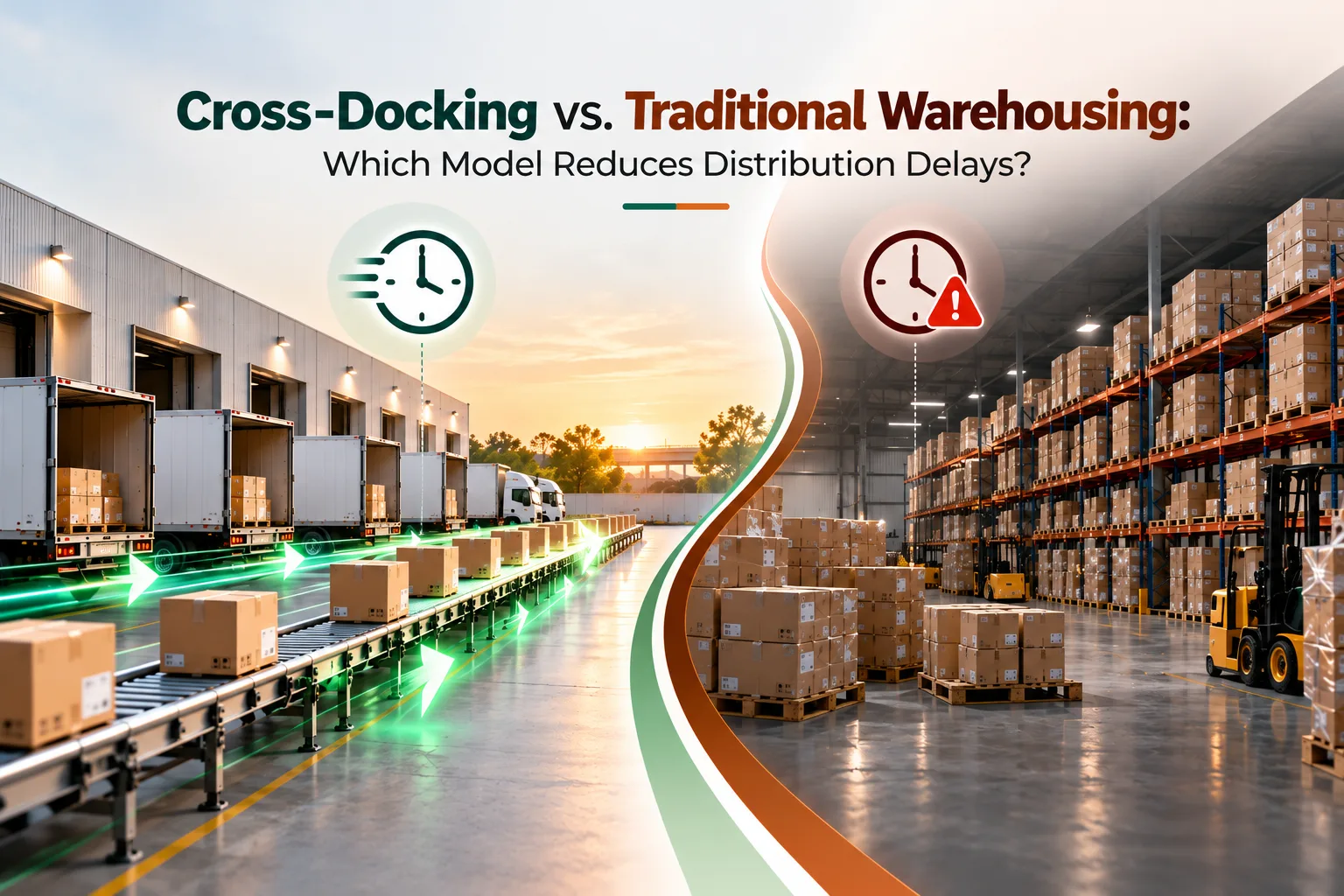
To address these challenges, businesses often choose between two logistics models: cross-docking and traditional warehousing. While traditional warehousing focuses on storing goods before dispatch, cross-docking aims to move products directly from incoming shipments to outgoing vehicles with minimal storage time.
Understanding the differences between these models can help businesses select the right distribution strategy for their supply chain.
What Is Cross-Docking?
Cross-docking is a logistics process in which incoming goods are transferred directly to outgoing vehicles, with little or no long-term storage in between.
When a shipment arrives at a distribution facility, products are sorted, consolidated, and prepared for their next destination. This approach reduces the time goods spend inside a warehouse.
Benefits of Cross-Docking
- Faster distribution: Products move through the facility with minimal storage delays.
- Lower storage costs: Reduced inventory holding and warehouse space requirements.
- Fewer handling steps: Less movement between storage locations can improve operational efficiency.
- Improved delivery coordination: Shipments can be consolidated according to destination and delivery schedules.
Challenges of Cross-Docking
Cross-docking requires accurate shipment information, coordinated transportation schedules, and efficient dock operations. If incoming trucks arrive late or outgoing vehicles are unavailable, shipments can become delayed.
It is generally more suitable when demand is predictable, products are ready for onward distribution, and transportation partners can coordinate effectively.
What Is Traditional Warehousing?
Traditional warehousing involves receiving goods, storing them for a period, and dispatching them when orders are ready or demand arises.
Businesses use warehouses to maintain inventory, manage fluctuating demand, and ensure products remain available when customers place orders.
Benefits of Traditional Warehousing
- Better inventory availability: Products can be stored until they are needed.
- Flexible order fulfilment: Goods can be picked and packed according to individual customer requirements.
- Support for seasonal demand: Businesses can stock products ahead of festivals, sales, or peak periods.
- A buffer against disruptions: Stored inventory can help maintain supply when replenishment is delayed.
Challenges of Traditional Warehousing
Traditional warehousing can increase distribution time when goods require multiple handling stages, lengthy storage, picking, packing, and dispatch preparation.
Poor inventory organisation, warehouse congestion, and inefficient order processing can further delay shipments.
However, well-managed warehouses with accurate inventory systems and streamlined processes can still support fast and reliable deliveries.
Cross-Docking vs. Traditional Warehousing: Key Differences
| Factor | Cross-Docking | Traditional Warehousing |
| Storage time | Minimal | Short- or long-term |
| Distribution speed | Potentially faster | Depends on storage and fulfilment processes |
| Handling requirements | Generally fewer storage-related steps | May involve receiving, put-away, picking, and packing |
| Storage costs | Generally lower | Generally higher |
| Inventory flexibility | Limited buffer stock | Greater flexibility through stored inventory |
| Best suited for | Predictable, fast-moving shipments | Variable demand and inventory-based fulfilment |
Which Model Reduces Distribution Delays?
Cross-docking can reduce distribution delays when goods are already allocated to destinations and incoming and outgoing transportation schedules are well coordinated.
For example, a distributor receiving pre-sorted products for several retail outlets may transfer them directly to destination-specific trucks instead of storing them first. This can reduce unnecessary handling and shorten the time between receiving and dispatch.
Traditional warehousing, however, can be more reliable when businesses need to hold stock, combine multiple orders, or respond to unpredictable customer demand. Having products available locally may prevent delays caused by waiting for new shipments from suppliers.
Therefore, cross-docking can shorten the distribution process, while traditional warehousing can provide greater flexibility and inventory availability. The actual result depends on shipment volume, warehouse efficiency, demand patterns, and transport coordination.
Which Industries Can Benefit from Each Model?
Industries Suited to Cross-Docking
- Retail and FMCG: Fast-moving products that need frequent distribution to stores.
- E-commerce: Pre-sorted orders and shipments moving between fulfilment or distribution centres.
- Automotive: Components delivered according to coordinated production schedules.
- Food distribution: Suitable products that need rapid movement and controlled handling.
Industries Suited to Traditional Warehousing
- Seasonal businesses: Products that must be stocked ahead of periods of high demand.
- Manufacturing: Raw materials and components needed to support production continuity.
- Wholesale distribution: Large product ranges with varying order quantities.
- Businesses with unpredictable demand: Operations that need buffer inventory to manage fluctuations.
Product characteristics and applicable handling requirements must also be considered before selecting either model.
How Businesses Can Reduce Distribution Delays
Regardless of the warehousing model, businesses can improve distribution performance through better planning and coordination.
- Improve shipment visibility: Track incoming and outgoing shipments to identify potential delays early.
- Coordinate transportation schedules: Ensure vehicle arrivals and departures align with warehouse operations.
- Use inventory management systems: Maintain accurate stock and order information.
- Optimise warehouse processes: Reduce unnecessary handling, congestion, and paperwork.
- Monitor delivery performance: Track dispatch time, order fulfilment time, and on-time delivery rates.
Combining reliable transportation with efficient warehouse management can help businesses build a more responsive supply chain.
Conclusion
Cross-docking and traditional warehousing serve different distribution needs. Cross-docking can reduce handling time and accelerate product movement, while traditional warehousing provides inventory flexibility and helps businesses manage changing demand.
The right choice depends on how goods move through the supply chain, how predictable customer demand is, and how effectively transportation and warehouse operations are coordinated.
For many businesses, a combination of both models can provide a practical balance between faster distribution and dependable inventory availability.
Looking for reliable transportation and logistics support? Visit SK Translines to explore logistics solutions designed to support efficient freight movement and distribution operations.