


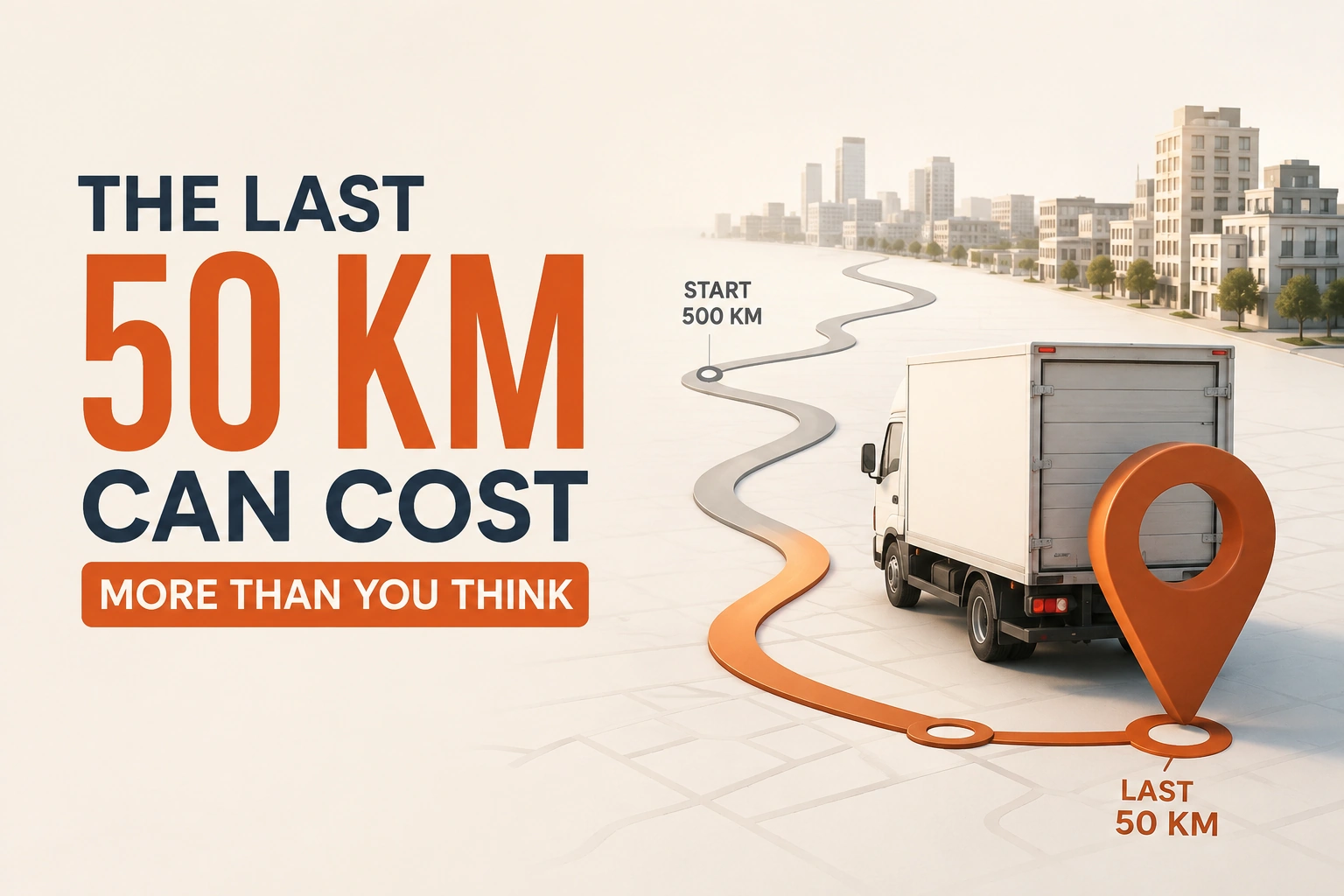
Moving goods across hundreds of kilometres may sound like the expensive part of logistics. Surprisingly, the final stretch of a shipment can sometimes cost more per kilometre than the entire long-distance journey.
This is the challenge of last-mile logistics.
A truck may travel 500 kilometres efficiently on highways, only to spend hours completing the final 50 kilometres through congested roads, multiple delivery points, restricted entry zones, and complicated unloading schedules.
So why does the shortest part of the journey often become the most expensive?
Long-Distance Transport Is More Predictable
Highway transportation is generally easier to plan.
Once a truck leaves the origin, it can travel long distances with relatively fewer interruptions. Routes are predictable, vehicles maintain steady speeds, and one truck may carry a large shipment directly toward its destination.
This allows transporters to spread fuel, driver, and vehicle costs across hundreds of kilometres.
The final stage is very different.
City Traffic Changes Everything
As soon as a vehicle enters an urban area, efficiency can drop quickly.
Traffic congestion, narrow roads, construction zones, traffic signals, and restricted truck movement can turn a short journey into several hours of driving.
The truck is still consuming fuel, the driver is still working, and the vehicle is still unavailable for another trip.
But very little distance is actually being covered.
That means the cost per kilometre increases significantly.
One Truck Becomes Multiple Deliveries
Long-distance transportation often involves moving a large quantity of goods from one location to another.
Last-mile delivery usually involves breaking that shipment into smaller deliveries.
One truck may need to stop at five, ten, or even more locations.
At every stop, the driver may need to:
- Find the delivery location
- Wait for entry
- Complete documentation
- Coordinate with the customer
- Unload goods
- Confirm delivery
Each stop adds time and operational cost.
The truck may only travel a few kilometres between deliveries, but the hours spent completing them continue to increase.
Waiting Time Is Expensive
One of the biggest hidden costs in last-mile logistics is waiting.
A truck might reach a customer on time but still wait because the loading bay is occupied, the receiving team is unavailable, documentation is incomplete, or unloading equipment is not ready.
During this time, the vehicle produces no additional revenue.
If delays happen at multiple delivery points, the truck may lose an entire working day while covering only a small distance.
Smaller Vehicles May Be Required
Large trucks are highly efficient for long-distance transportation because they can carry more goods in a single trip.
However, they may not be suitable for the final delivery.
Some cities have vehicle restrictions, limited road space, low-clearance areas, or delivery-time regulations.
Businesses may need to transfer goods to smaller commercial vehicles before completing delivery.
This creates additional costs for handling, sorting, drivers, vehicles, and local distribution.
Failed Deliveries Make It Even More Expensive
Imagine a truck travels 20 kilometres to complete a delivery, but the customer is unavailable or the warehouse refuses the shipment.
The vehicle may have to return later.
Now the same delivery requires additional fuel, driver time, route planning, and vehicle capacity.
One failed delivery can dramatically increase the total cost of fulfilling that order.
Visibility Makes the Difference
The last mile will always have more variables than highway transportation, but better planning can reduce its cost.
Businesses can improve last-mile efficiency through:
Route optimisation to reduce unnecessary travel.
Real-time tracking to identify delays early.
Delivery scheduling to reduce waiting time.
Customer communication to confirm availability before arrival.
Vehicle planning to assign the right vehicle for each route.
Shipment consolidation to combine nearby deliveries efficiently.
The objective is not simply to drive fewer kilometres. It is to make every kilometre more productive.
Final Thoughts
The first 500 kilometres may look like the biggest part of a shipment, but they often happen under predictable and efficient conditions.
The last 50 kilometres involve traffic, multiple stops, waiting, smaller vehicles, customer coordination, unloading, and the possibility of failed deliveries.
That is why in logistics, distance does not always determine cost—complexity does.
Sometimes the shortest part of the journey is where the real logistics challenge begins.