


Modern transportation involves much more than moving goods from one location to another. Transport companies must manage vehicles, drivers, customers, freight rates, invoices, documentation, delivery schedules, fuel expenses and shipment tracking at the same time.
When these activities are handled through separate spreadsheets, phone calls and disconnected software, mistakes and delays become difficult to avoid.
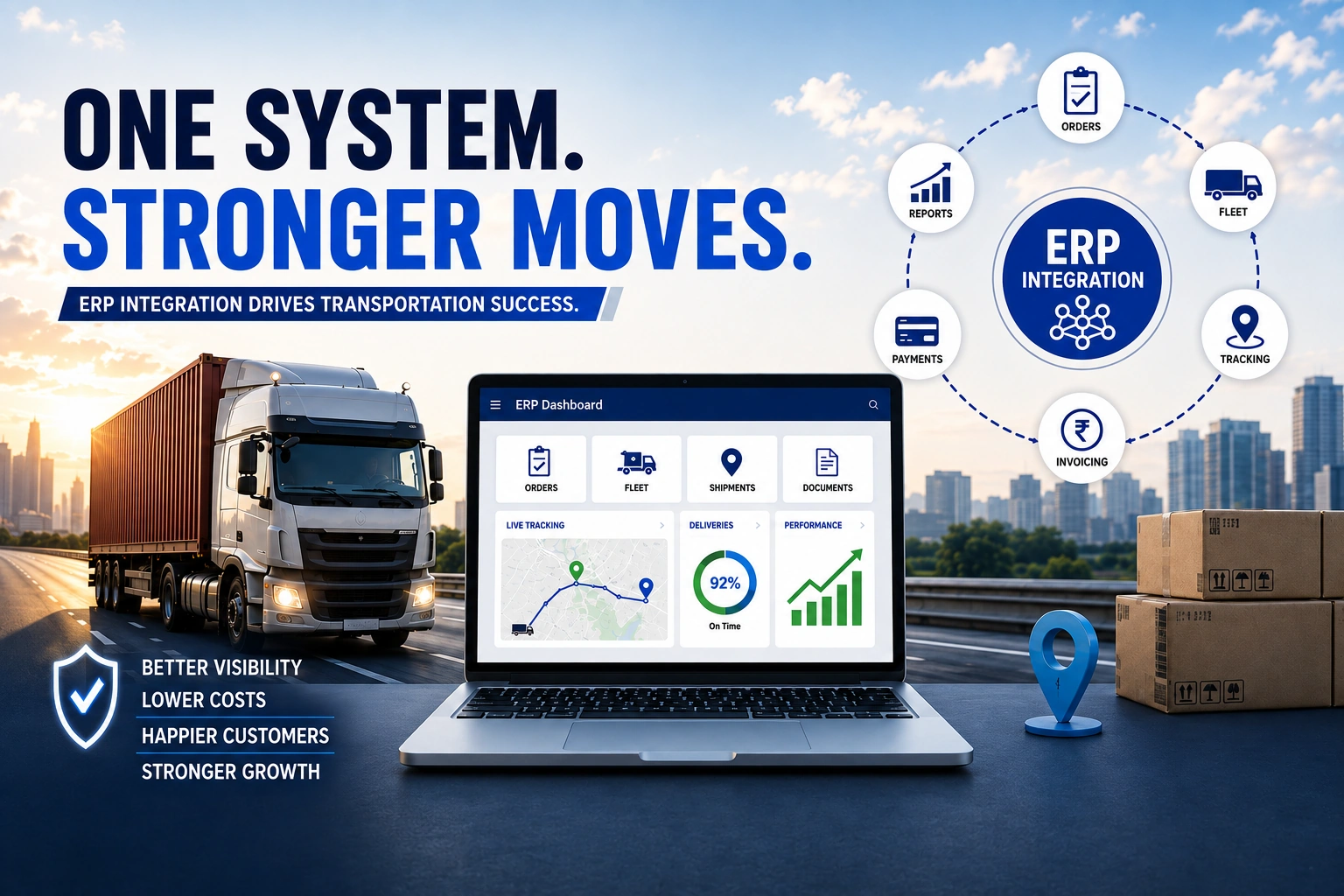
ERP integration brings transportation operations into one connected system. It helps businesses improve visibility, reduce manual work and make faster decisions across the entire logistics process.
What Is ERP Integration in Transportation?
ERP stands for Enterprise Resource Planning.
In transportation, an ERP system connects different business functions such as:
- Order management
- Vehicle allocation
- Driver management
- Freight calculation
- Lorry receipt generation
- E-way bill details
- Shipment tracking
- Fuel and trip expenses
- Invoicing
- Payments and accounting
- Delivery confirmation
- Customer communication
Instead of maintaining separate records for every department, ERP integration creates a central source of information.
For example, when a shipment order is created, the same data can be used for vehicle planning, documentation, tracking, billing and reporting.
Reduces Manual Data Entry
Transportation teams often enter the same information multiple times.
Customer details may be added to an order, copied into an LR, entered again in an invoice and then manually updated in an accounting system.
This increases the risk of:
- Typing mistakes
- Duplicate records
- Incorrect shipment details
- Billing errors
- Documentation mismatches
- Delayed updates
An integrated ERP allows information to move automatically between departments. Once the data is entered correctly, it can be reused throughout the transportation process.
This saves time and improves accuracy.
Improves Shipment Visibility
A modern ERP system gives managers a clearer view of ongoing transport operations.
They can check:
- Which shipments are awaiting dispatch
- Which vehicles have been assigned
- Where each shipment is currently located
- Which deliveries are delayed
- Which documents are incomplete
- Which invoices are pending
- Which customers require updates
This central visibility helps teams respond quickly instead of searching through emails, spreadsheets and phone messages.
Connects Operations With Accounts
One of the biggest problems in transportation is the gap between operations and finance.
The operations team may know that a shipment has been delivered, but the accounts team may not receive the required documents on time. This can delay invoicing and payment collection.
ERP integration connects trip completion with financial processes.
Once a delivery is confirmed, the system can help:
- Calculate freight
- Record additional charges
- Generate invoices
- Attach proof of delivery
- Track customer payments
- Record transporter expenses
- Calculate trip profitability
This reduces billing delays and improves cash flow.
Makes Documentation More Accurate
Transportation requires several documents, including:
- Invoice
- E-way bill
- Lorry receipt
- Delivery challan
- Vehicle documents
- Proof of delivery
- Freight bill
Errors between these documents can create compliance problems or shipment delays.
An ERP system can use the same master data across all documents. Customer names, GST details, addresses, vehicle numbers and shipment information remain consistent throughout the process.
This reduces document mismatches and improves compliance control.
Improves Vehicle and Driver Planning
Efficient vehicle utilisation is important for controlling transport costs.
An ERP system can help managers review:
- Available vehicles
- Vehicle capacity
- Current vehicle location
- Driver availability
- Maintenance schedules
- Route requirements
- Load type
- Delivery deadlines
This allows businesses to assign the right vehicle and driver to each shipment.
Better planning reduces empty trips, overloading, unnecessary waiting and last-minute vehicle changes.
Supports Real-Time Tracking
ERP systems can be connected with GPS and telematics platforms.
This allows live vehicle data to appear directly inside the transport workflow.
Fleet managers can monitor:
- Vehicle location
- Route movement
- Unplanned stoppages
- Estimated arrival time
- Route deviations
- Geofence alerts
- Delivery progress
Because tracking data is connected to the shipment record, teams do not need to switch between multiple platforms.
Customers can also receive more accurate status updates.
Improves Customer Service
Customers expect timely deliveries and clear communication.
An integrated ERP helps customer-service teams access reliable shipment information without repeatedly contacting drivers or operations staff.
They can quickly answer questions such as:
- Has the shipment been dispatched?
- Which vehicle is carrying the goods?
- What is the expected delivery time?
- Has the shipment reached the destination?
- Is proof of delivery available?
- Has the invoice been generated?
Faster and more accurate communication improves customer trust.
Helps Control Transportation Costs
Transportation businesses deal with many direct and indirect costs, including:
- Fuel
- Tolls
- Driver allowances
- Vehicle maintenance
- Loading and unloading
- Market vehicle freight
- Detention charges
- Route expenses
- Damage claims
An ERP system can record these expenses against individual trips or shipments.
This helps management understand:
- Cost per trip
- Cost per kilometre
- Vehicle profitability
- Route profitability
- Customer profitability
- Budget versus actual expense
Better cost visibility helps businesses identify waste and improve pricing decisions.
Strengthens Compliance and Audit Records
Transportation companies must maintain records for taxation, vehicle movement, freight billing and delivery confirmation.
ERP systems create a digital trail of activities such as:
- Who created or updated a shipment
- When a vehicle was assigned
- When documents were generated
- When the shipment was dispatched
- When delivery was completed
- When the invoice was issued
These records improve accountability and make audits easier.
Supports Better Decision-Making
ERP integration converts daily operational data into useful reports.
Management can analyse:
- On-time delivery performance
- Vehicle utilisation
- Freight revenue
- Pending payments
- Frequent delay reasons
- Route performance
- Fuel consumption
- Damage and shortage cases
- Customer-wise business volume
Without integration, this information may remain scattered across different files.
A centralised ERP helps leaders make decisions based on accurate data rather than assumptions.
Helps Transportation Businesses Scale
Manual processes may work when a company manages a small number of vehicles and shipments.
As the business grows, the volume of orders, documents, customers and financial transactions also increases.
An integrated ERP creates standard workflows that can support this growth. New branches, vehicles, employees and customers can be added without completely changing the way the business operates.
This makes expansion easier and more controlled.
Final Thoughts
ERP integration is becoming essential for modern transportation businesses.
It connects operations, tracking, documentation, fleet management, finance and customer service within one system. This reduces manual work, improves accuracy and provides better control over every shipment.
For transport companies, ERP integration is not only about digitising existing processes. It is about creating a faster, more transparent and scalable way to manage the entire transportation operation.
Businesses that adopt integrated systems can respond more quickly, control costs more effectively and provide a better experience to their customers.