


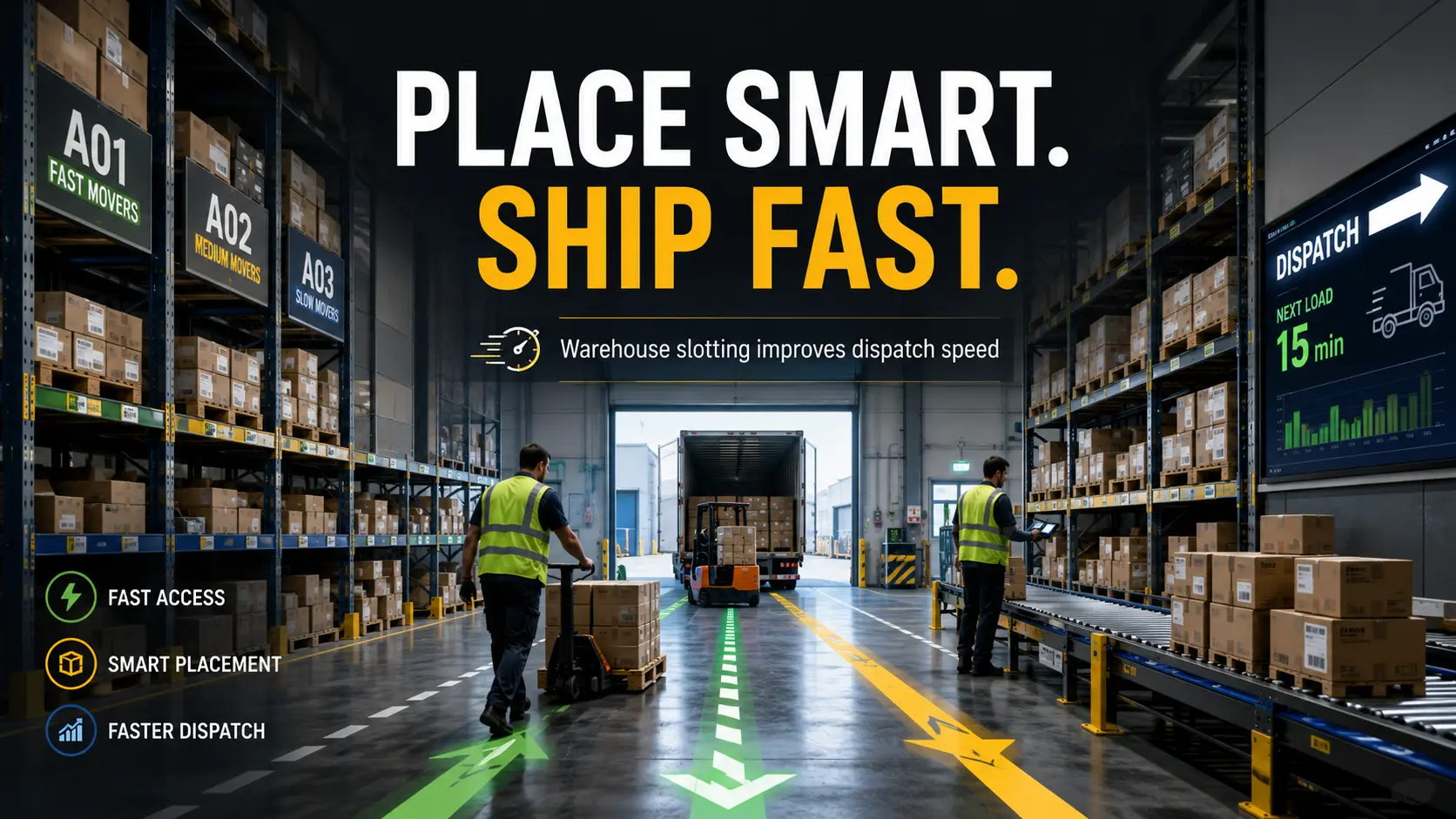
Fast dispatch does not begin when a customer places an order. It begins much earlier, with how products are arranged inside the warehouse.
Warehouse slotting is the process of placing products in the most suitable storage locations based on factors such as demand, size, weight, handling requirements and order frequency. When products are positioned strategically, warehouse teams can pick, pack and dispatch orders faster while reducing unnecessary movement and operational errors.
What Is Warehouse Slotting?
Warehouse slotting involves deciding where every product should be stored within a warehouse.
Instead of placing inventory wherever space is available, products are assigned locations based on how frequently they are ordered and how easily they need to be accessed.
For example, fast-moving products may be stored close to packing and dispatch areas, while slow-moving products can be kept in higher racks or less accessible sections.
Effective slotting considers:
- Product demand and order frequency
- Product size and weight
- Storage and handling requirements
- Products commonly ordered together
- Shelf life and expiry dates
- Available warehouse space
- Picking equipment and worker safety
Why Product Placement Matters
Poor product placement increases the time workers spend walking, searching and handling goods. Even a few extra minutes per order can create significant delays when hundreds of orders are processed each day.
Strategic placement allows workers to follow shorter and more efficient picking routes. It also reduces congestion in busy warehouse areas and helps orders move smoothly from storage to packing and dispatch.
How Warehouse Slotting Improves Dispatch Speed
1. Reduces Picking Time
Order picking is often one of the most time-consuming warehouse activities.
When high-demand products are stored near packing stations or dispatch areas, workers can retrieve them quickly. This reduces travel distance and helps more orders get processed during each shift.
2. Creates More Efficient Picking Routes
Random product placement forces workers to move repeatedly across different warehouse zones.
Proper slotting groups products according to order patterns, allowing teams to follow planned and efficient routes. Products that are frequently ordered together can also be stored close to one another.
3. Prevents Congestion
Storing all fast-moving products in one small area may create overcrowding.
A good slotting strategy distributes popular inventory across suitable zones, ensuring that multiple workers and material-handling vehicles can operate without blocking one another.
This improves workflow and reduces waiting time.
4. Speeds Up Packing
Product placement also affects packing efficiency.
When goods reach the packing area in the correct order and without unnecessary handling, teams can verify, pack and label shipments more quickly. Proper slotting also reduces the risk of damaged goods reaching the packing station.
5. Reduces Picking Errors
Well-organised storage locations make products easier to identify.
Clear labelling, logical placement and barcode-based tracking reduce the possibility of selecting the wrong item, quantity or product variant. Fewer errors mean fewer order corrections, shipment delays and returns.
6. Improves Space Utilisation
Slotting ensures that warehouse space is used according to product dimensions and movement patterns.
Small products can be stored in compact locations, while heavy or bulky products can be placed at ground level or near loading areas. This creates more usable storage capacity and improves accessibility.
7. Supports Faster Replenishment
Picking locations must be replenished regularly from reserve storage.
When replenishment zones are organised properly, warehouse teams can refill picking shelves before inventory runs out. This prevents order processing from stopping because a product is unavailable at its assigned location.
Common Warehouse Slotting Methods
ABC Classification
ABC analysis groups inventory according to demand or business value.
- A-category products are fast-moving and should be placed in easily accessible locations.
- B-category products have moderate demand and can be stored in secondary picking areas.
- C-category products move slowly and can be placed in less accessible warehouse sections.
Velocity-Based Slotting
This method places products according to how quickly they move through the warehouse. High-velocity inventory remains close to dispatch areas, while low-velocity inventory is stored farther away.
Zone-Based Slotting
The warehouse is divided into different zones based on product type, handling needs or order category. This method is particularly useful for warehouses handling fragile, temperature-sensitive, hazardous or oversized goods.
Family Grouping
Products frequently ordered together are placed near one another. This reduces travel time and simplifies the picking process for common order combinations.
Factors to Consider Before Changing Product Locations
Warehouse slotting should be based on accurate operational data rather than assumptions.
Businesses should review:
- Historical sales and order data
- Seasonal demand fluctuations
- Product dimensions and weight
- Order combinations
- Picking frequency
- Replenishment requirements
- Storage equipment
- Worker movement and safety
- Dispatch schedules
Slotting decisions should also be reviewed regularly because demand patterns, product ranges and customer requirements can change.
The Role of Technology in Warehouse Slotting
Warehouse Management Systems can analyse inventory movement and recommend suitable storage locations.
Barcode scanners, RFID systems and real-time inventory tracking help businesses monitor product movement and identify inefficient warehouse layouts. Heat maps and picking data can also show which areas experience high traffic or frequent delays.
Technology allows warehouse managers to continuously improve placement decisions instead of relying only on manual observation.
Best Practices for Effective Warehouse Slotting
Businesses can improve slotting results by:
- Keeping fast-moving products close to dispatch areas
- Placing heavy goods at lower levels
- Separating fragile and hazardous inventory
- Grouping frequently ordered products together
- Maintaining clear aisle and rack labels
- Avoiding congestion near high-demand products
- Reviewing seasonal inventory requirements
- Monitoring picking time and travel distance
- Updating product locations as demand changes
Regular audits are essential to ensure the warehouse layout continues to support current operations.
Conclusion
Warehouse slotting is more than a storage strategy. It directly affects picking speed, order accuracy, worker productivity and overall dispatch performance.
By placing products according to demand, size, handling needs and order patterns, businesses can reduce unnecessary movement and process shipments faster.
An organised warehouse helps goods move smoothly from storage to picking, packing and loading. For logistics-driven businesses, improving product placement can be one of the simplest and most effective ways to achieve faster, more reliable dispatch operations.