


Modern logistics is no longer just about moving goods from one point to another. Today, businesses need speed, visibility, coordination, cost control and real-time decision-making. With multiple transport modes, vendors, warehouses, customers and delivery timelines involved, logistics operations have become more complex than ever.
This is where logistics control towers play an important role.
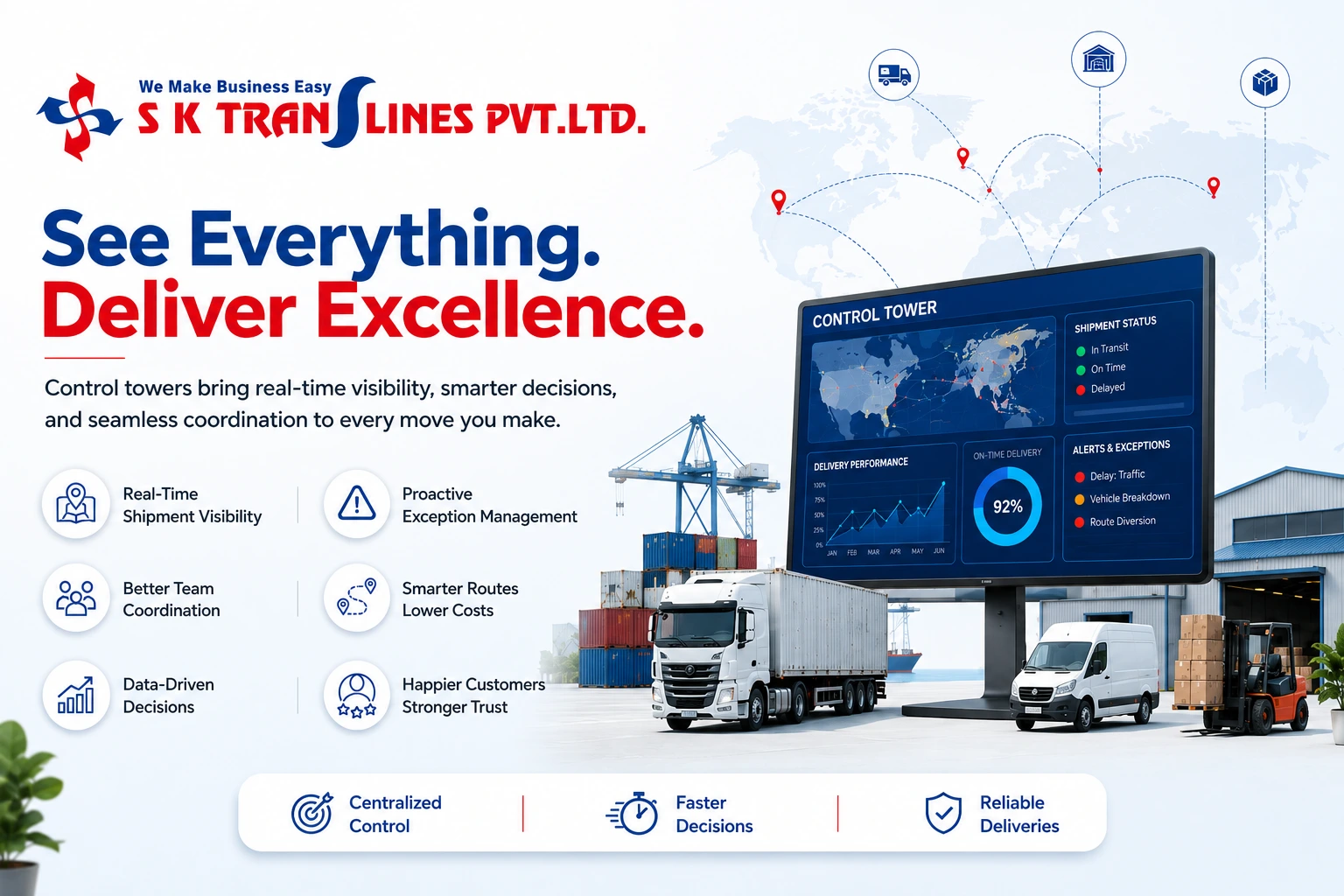
A control tower acts as a central command center for logistics operations. It brings together shipment data, vehicle movement, warehouse updates, route status, delivery timelines and exception alerts into one connected platform. Instead of working with scattered information from different teams and systems, companies get a clear real-time view of their entire supply chain.
What Is a Logistics Control Tower?
A logistics control tower is a centralized system that helps companies monitor, manage and optimize logistics activities. It collects data from transport management systems, GPS tracking, warehouse systems, ERP platforms, carriers and customer service teams.
According to DHL, a supply chain control tower works like a digital platform that provides end-to-end visibility and control across logistics activities. It helps businesses manage the movement of goods more efficiently through real-time information and better coordination.
In simple terms, a control tower helps logistics teams answer important questions such as:
Where is the shipment right now?
Is the vehicle running on time?
Is there any delay or route issue?
Which delivery needs urgent attention?
Are transport costs under control?
How can we improve future planning?
Why Control Towers Matter in Modern Logistics
In traditional logistics, teams often depend on phone calls, manual updates, spreadsheets and delayed reports. This creates gaps in communication and slows down decision-making. By the time a problem is identified, it may already have affected delivery performance or customer satisfaction.
A control tower solves this by providing a single view of operations. It helps teams track shipments, identify delays, manage exceptions and make faster decisions.
Modern control towers are especially useful for companies that manage high shipment volumes, multiple branches, multimodal transport, third-party carriers or time-sensitive deliveries.
Key Functions of a Logistics Control Tower
1. Real-Time Shipment Visibility
One of the biggest benefits of a control tower is real-time visibility. Businesses can track vehicles, shipments, routes and delivery milestones from a single dashboard.
This reduces dependency on manual follow-ups and helps teams stay updated at every stage. Whether goods are moving by road, rail, air, or multimodal transport, a control tower gives better control over the entire journey.
2. Proactive Exception Management
Delays, breakdowns, traffic congestion, route changes, documentation issues and weather disruptions can affect logistics operations. A control tower helps identify these issues early.
Instead of reacting after the problem becomes serious, logistics teams receive alerts and can take quick action. This improves delivery reliability and reduces operational losses.
3. Better Coordination Between Teams
Logistics involves many stakeholders including transporters, drivers, warehouse teams, sales teams, customer support, vendors and clients. Without proper coordination, communication gaps can create confusion.
A control tower connects all important information in one place. This helps teams work with the same data, reduces duplicate communication, and improves accountability.
4. Improved Route and Resource Planning
Control towers help companies analyze route performance, vehicle utilization, carrier efficiency, delivery delays and cost patterns. This data supports better planning.
Businesses can choose better routes, assign the right vehicles, reduce empty runs, improve load planning and optimize delivery schedules.
5. Faster Customer Communication
Customers today expect regular updates and accurate delivery timelines. If a shipment is delayed, they want to know the reason and expected resolution.
With a control tower, customer service teams can access real-time shipment information and provide faster responses. This improves trust and customer experience.
6. Cost Control and Performance Monitoring
Logistics costs can increase due to delays, fuel wastage, poor route planning, idle vehicles, penalties and inefficient carrier usage. A control tower helps monitor these factors.
It provides dashboards and reports on delivery performance, transport cost, vehicle productivity, route efficiency and service levels. DHL also defines a control tower as a central hub that uses end-to-end visibility and real-time analytics to manage logistics performance and control costs.
7. Data-Driven Decision-Making
A control tower does not only show what is happening now. It also helps businesses understand patterns and make better future decisions.
For example, companies can analyze which routes face frequent delays, which carriers perform better, which locations need more planning and where costs can be reduced.
This turns logistics from a reactive function into a more strategic and data-driven operation.
Benefits of Control Towers in Logistics
A well-designed control tower can bring several advantages to logistics operations:
Improved shipment visibility
Faster issue resolution
Better delivery performance
Reduced manual follow-ups
Stronger coordination between teams
Lower logistics costs
Improved customer satisfaction
Better use of vehicles and resources
Higher operational transparency
More accurate reporting and planning
By connecting people, processes, data and technology, control towers help companies build more resilient logistics operations.
Control Towers and Technology
Modern logistics control towers are powered by technologies such as GPS tracking, IoT, ERP systems, transport management systems, warehouse management systems, analytics dashboards, automation and artificial intelligence.
These technologies help convert raw logistics data into useful insights. Advanced control towers can also predict delays, recommend better routes, automate alerts and support faster decision-making.
A supply chain control tower is often described as a centralized platform that aggregates real-time data and uses it to surface exceptions, guide decisions, and drive action. It does not replace execution systems but connects them to create a shared operational view.
Challenges in Implementing a Control Tower
While control towers offer strong benefits, implementation requires proper planning. Companies may face challenges such as:
Data coming from multiple systems
Lack of real-time updates from partners
Poor integration with existing ERP or TMS platforms
Resistance from teams using manual processes
Inaccurate or incomplete operational data
High dependency on process discipline
To overcome these challenges, businesses should start with clear goals. They should define what they want to track, which teams will use the system, what alerts are important and how decisions will be taken based on the data.
The Future of Logistics Control Towers
The role of control towers will continue to grow as logistics becomes more digital, connected and customer-focused. In the future, control towers will not only monitor operations but also predict risks, recommend solutions, automate workflows and improve supply chain resilience.
With AI and advanced analytics, businesses will be able to move from real-time visibility to predictive logistics. This means they can identify possible delays before they happen and take preventive action.
For modern logistics companies, control towers are no longer just an advanced feature. They are becoming an essential part of efficient and reliable supply chain management.
Conclusion
Control towers play a powerful role in modern logistics operations by giving companies better visibility, faster control, and smarter decision-making. They help businesses track shipments, manage exceptions, coordinate teams, reduce costs and improve customer service.
In a competitive logistics environment, companies that can see clearly and act quickly will always have an advantage. A logistics control tower gives them exactly that advantage.
It brings all logistics activities into one connected view and helps businesses move from manual follow-ups to intelligent operations. For any company aiming to improve efficiency, reliability and customer satisfaction, a control tower is a strong step toward smarter logistics management.