


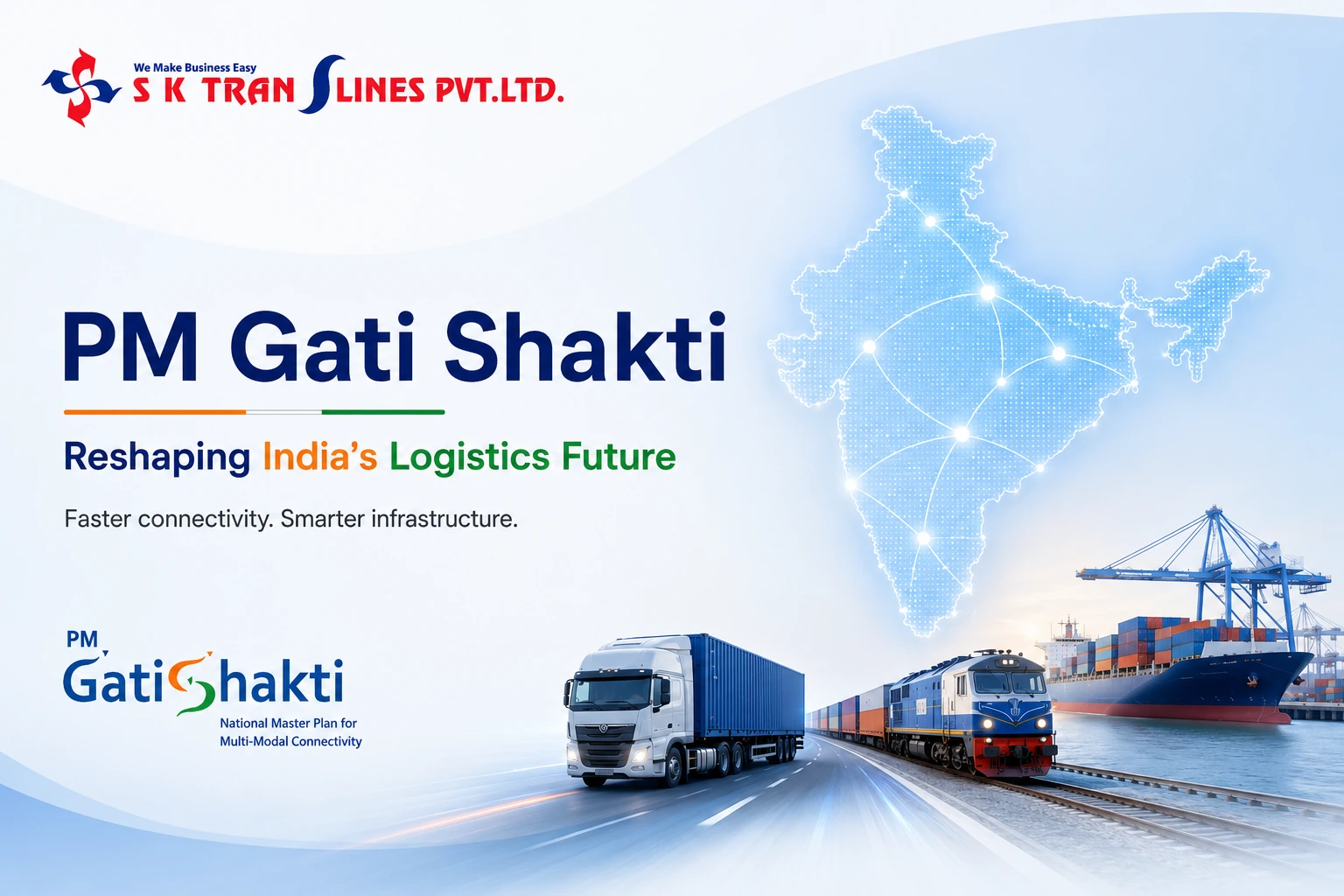
India’s logistics sector is changing fast. Businesses now need faster movement of goods, better route connectivity, lower transit delays and stronger coordination between road, rail, ports, airports and warehouses.
For many years, infrastructure planning in India often happened in separate departments. Roads, railways, ports and industrial zones were planned independently. This sometimes created gaps in connectivity and delays in project execution.
PM Gati Shakti was introduced to solve this problem through integrated planning and multimodal connectivity. The PM Gati Shakti National Master Plan was launched on October 13, 2021 as a digital platform to bring ministries such as Railways and Roadways together for coordinated infrastructure planning and execution.
What Is PM Gati Shakti?
PM Gati Shakti is a National Master Plan designed to improve multimodal infrastructure connectivity across India.
It uses data, GIS mapping and digital planning tools to help different government departments plan infrastructure projects in a coordinated way. The DPIIT describes PM Gati Shakti as a technology-backed GIS-based decision support system for integrated planning, synchronized implementation and project monitoring.
The goal is simple: connect economic zones, industrial areas, ports, roads, railways, airports and logistics hubs more efficiently.
1. It Promotes Integrated Infrastructure Planning
One of the biggest changes brought by PM Gati Shakti is integrated planning.
Instead of departments planning projects separately, multiple ministries can view infrastructure data on one platform. This helps identify missing links, route gaps, project overlaps and connectivity issues at the planning stage.
For logistics, this is important because goods movement depends on more than one mode of transport.
A shipment may need road transport, rail movement, port handling and last-mile delivery. Better planning between these systems can reduce delays and improve movement efficiency.
2. It Strengthens Multimodal Connectivity
Modern logistics needs smooth movement between different transport modes.
PM Gati Shakti focuses on seven key infrastructure engines: Railways, Roads, Ports, Waterways, Airports, Mass Transport and Logistics Infrastructure.
This helps create stronger links between production centers, consumption markets, warehouses, ports and transport corridors.
For businesses, better multimodal connectivity can mean faster dispatches, better route options and improved delivery reliability.
3. It Reduces Infrastructure Bottlenecks
Poor connectivity can increase logistics costs.
For example, a warehouse may be close to a highway but far from rail access. A port may have capacity but weak road connectivity. A manufacturing cluster may face delays because of poor last-mile infrastructure.
PM Gati Shakti helps planners identify such bottlenecks using data layers such as economic nodes, social nodes and logistics nodes. The Ministry of Road Transport and Highways has stated that National Highway projects are planned in line with PM Gati Shakti National Master Plan principles.
This improves the chances of building infrastructure where it is actually needed.
4. It Supports Faster Project Execution
Infrastructure delays affect logistics performance.
When roads, rail lines, terminals and connectivity projects are delayed, businesses face higher transit time and uncertain delivery schedules.
PM Gati Shakti improves coordination between departments. It allows project stakeholders to review dependencies early and plan execution in a synchronized manner.
This can help reduce delays caused by lack of coordination, repeated approvals and disconnected project planning.
5. It Improves Freight Movement
India’s logistics sector depends heavily on efficient freight movement.
Better highways, rail connectivity, ports, freight corridors and logistics parks can help goods move faster across states.
PM Gati Shakti supports this by improving connectivity between key logistics points.
For logistics companies, better freight movement can lead to fewer route delays, improved vehicle turnaround time and better asset utilization.
6. It Helps Reduce Logistics Costs
High logistics cost affects business competitiveness.
When transport routes are inefficient, vehicles travel longer distances. When multimodal connectivity is weak, businesses depend too much on one mode of transport. When dispatch planning is poor, idle time increases.
PM Gati Shakti aims to improve infrastructure efficiency so goods can move through better planned networks.
Over time, better connectivity can help businesses reduce fuel costs, waiting time, unnecessary detours and handling delays.
7. It Encourages Data-Based Infrastructure Decisions
One of the strongest parts of PM Gati Shakti is its focus on data.
The platform supports planning through digital maps and multiple data layers. This helps decision-makers see roads, railways, ports, industrial clusters, warehouses and other infrastructure points together.
For logistics infrastructure, this data-led approach is useful because it supports practical decisions.
It helps answer questions such as:
Which route needs better connectivity?
Which industrial area needs stronger freight access?
Where should logistics hubs be developed?
Which bottleneck is affecting goods movement?
8. It Supports Industrial Growth
Logistics infrastructure directly affects industrial growth.
Factories, warehouses and export businesses need reliable movement of raw materials and finished goods. When connectivity improves, industries can reach suppliers and customers more efficiently.
PM Gati Shakti supports economic zones by improving links between production points and transport networks.
This can help manufacturers, exporters, transporters and supply chain businesses work with better speed and reliability.
9. It Improves Regional Connectivity
Strong logistics infrastructure should not be limited to major metro cities.
PM Gati Shakti also supports better connectivity for developing regions, industrial clusters and emerging logistics hubs.
Improved regional connectivity can help businesses reach new markets and reduce dependence on limited transport routes.
For transport companies, this opens opportunities for better route planning and wider service coverage.
10. It Builds a More Future-Ready Logistics System
The future of logistics will depend on speed, visibility, technology and multimodal movement.
PM Gati Shakti is helping India move toward a more connected logistics ecosystem.
By combining infrastructure planning with data and inter-ministerial coordination, it supports a stronger foundation for modern supply chains.
For businesses, this means better dispatch planning, smoother route connectivity and improved delivery performance.
Conclusion
PM Gati Shakti is reshaping India’s logistics infrastructure by improving integrated planning, multimodal connectivity and data-based decision-making.
It helps reduce infrastructure gaps, improve freight movement and support faster project execution.
For logistics companies and businesses that depend on reliable goods movement, PM Gati Shakti is not just an infrastructure initiative.
It is a major step toward building a faster, smarter and more connected logistics network for India.